Qanawat (Canatha)
The Decapolis city up in the hills: a rock-cut theatre, a colonnaded temple and a palace turned basilica. What stands at Qanawat and how long it takes.
- Opening hours
- The ruins lie inside the village and can be seen through the day; there is no fixed timetable
- Entry
- Variable — confirm at the entrance
- Duration
- 90 minutes
- Best time
- Morning; there are trees on the site but no shade on the temple platform
- Period
- Roman — Byzantine
- Address
- Qanawat, 7 kilometres north-east of As-Suwayda
Seven kilometres north-east of As-Suwayda, at twelve hundred metres, among trees and running water, there is a village — and beneath it Canatha of the Decapolis. The name turns up in Egyptian execration texts and in the Amarna letters; from Pompey to Trajan it was one of the self-governing cities of the Decapolis, and under Septimius Severus it became a colony called Septimia Canatha. The ruin field runs a kilometre and a half, and the houses of the village stand inside it.
Getting there
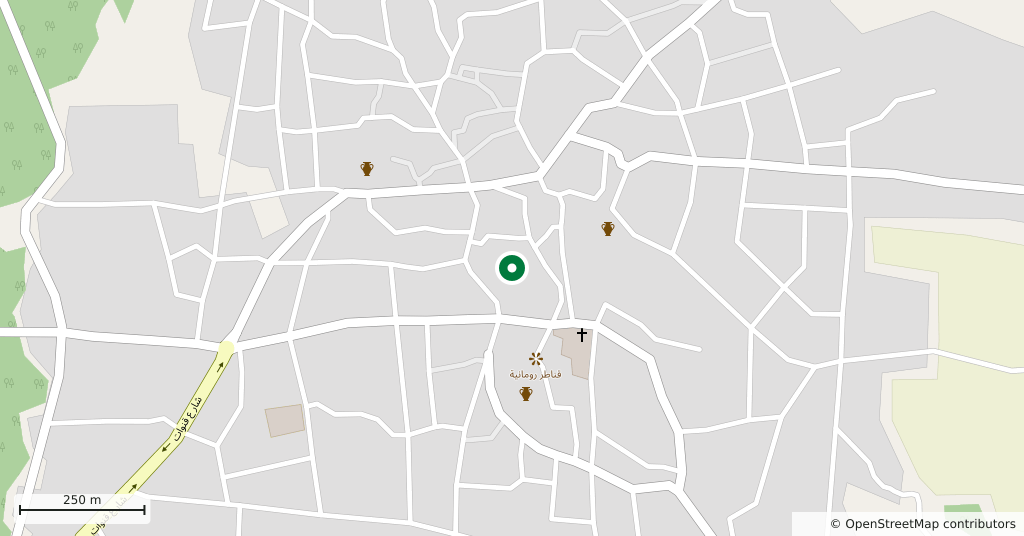
Seven kilometres from As-Suwayda, ten minutes by car. The ruins are gathered at the north-western edge of the village; you leave the car at the roadside and walk, with a few hundred metres between one monument and the next.
How long it takes
An hour and a half. Half an hour at the temple that became a basilica, half an hour at the theatre, the rest at the temple to the north-west and the water works.
What to see
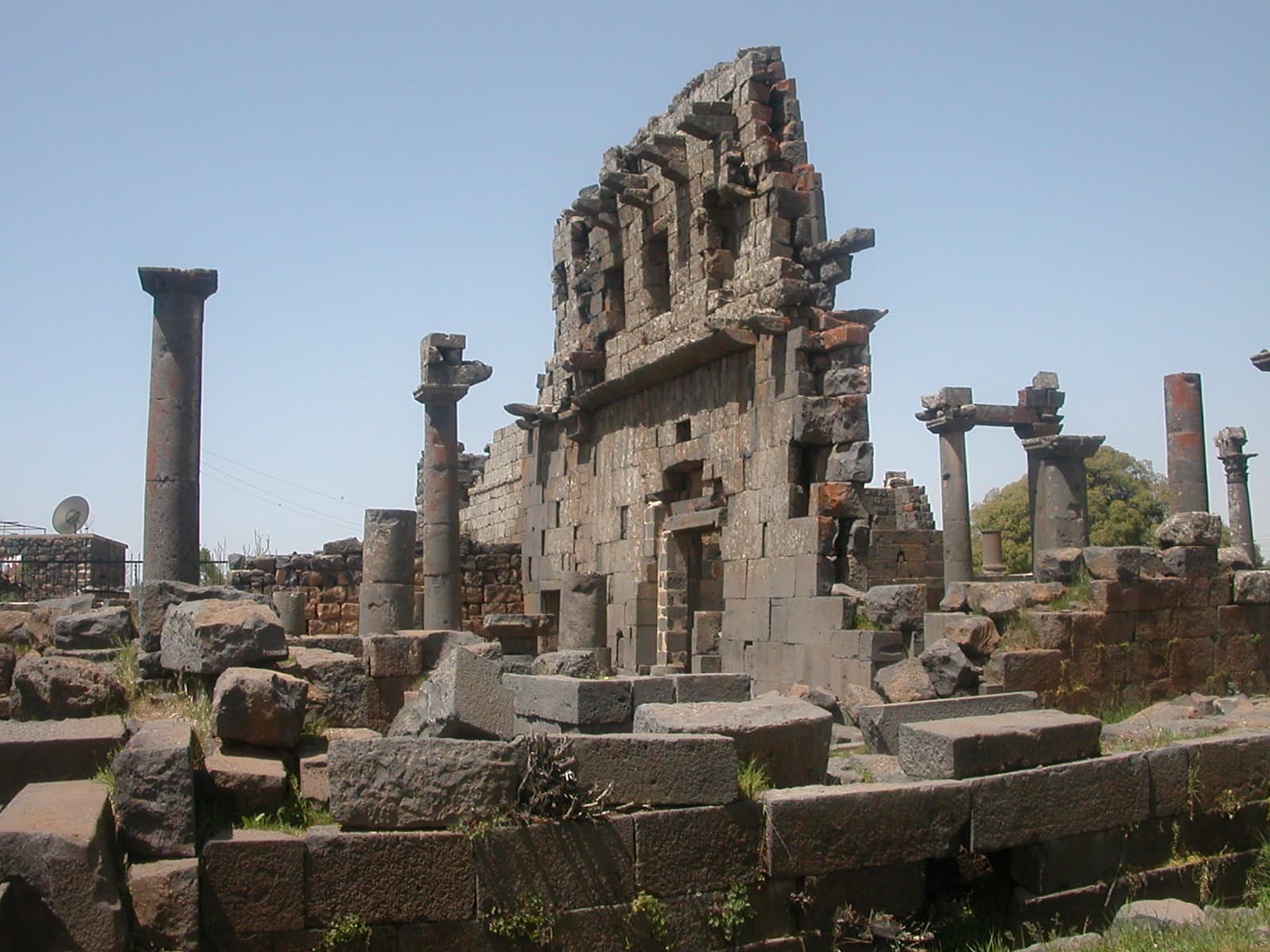
The building called the Seraya is the best preserved: raised as a temple in the second century and converted into a Christian basilica in the fourth or fifth. It is twenty-two metres long, with a portico in front and a courtyard of eighteen columns; the church was set on the temple walls, so both periods can be read in one façade. The theatre is small and cut into the rock: nine tiers of seats around an orchestra nineteen metres across. To the north-west a temple stands on a high platform, ringed by a colonnade — long thought to be dedicated to Helios until an inscription found in 2002 showed it belonged to a local god, Rabbos. Beyond these are a nymphaeum, an aqueduct and a Roman bridge.
What not to miss
Look at how the modern village sits on the ancient city. Qanawat was abandoned in the seventeenth and eighteenth centuries. When Druze families came down from Mount Lebanon in the 1820s this was one of the first places they settled, because the Roman paving, the empty houses and the water were already there. The ancient city is not only an excavation, then, but a settlement reoccupied two centuries ago. From the 1850s the village became the seat of the Druze religious leadership.
Where it stands now
Qanawat is in Suwayda governorate, which has been inside an armed conflict since July 2025. The present condition of the ruins cannot be confirmed from independent sources, and access to the site is not regular. This page tells you what Qanawat is; it does not tell you that you can go there today.
Tips
- Start at the Seraya; the theatre and the temple to the north-west are within walking distance
- The ground is strewn with basalt blocks and uneven — wear a thick sole
- At twelve hundred metres it runs a few degrees cooler than As-Suwayda, and evenings are cold
- The ruins adjoin people's houses; ask before stepping into a courtyard
Transparency
- How this was chosen
- Written by hand; opening hours, entry fee and coordinates are kept as data. A field that is not known for certain is marked as variable rather than guessed.
- Facts checked
- September 2026
- Last updated
- September 15, 2026