Saint George’s Cathedral: the Syriac Orthodox Patriarchate in Damascus
The Syriac Orthodox cathedral on Bab Touma Street has been the seat of the Antioch patriarchate since 1959. Entry free, patronal feast 6 May, ask at the gate.
- Opening hours
- Open at service times; outside them, ask the attendant at the gate
- Entry
- Free
- Duration
- 25 minutes
- Best time
- 6 May for the patronal feast, or Sunday morning during the liturgy
- Period
- Modern — 1951
- Address
- Bab Touma Street, Old City, Damascus
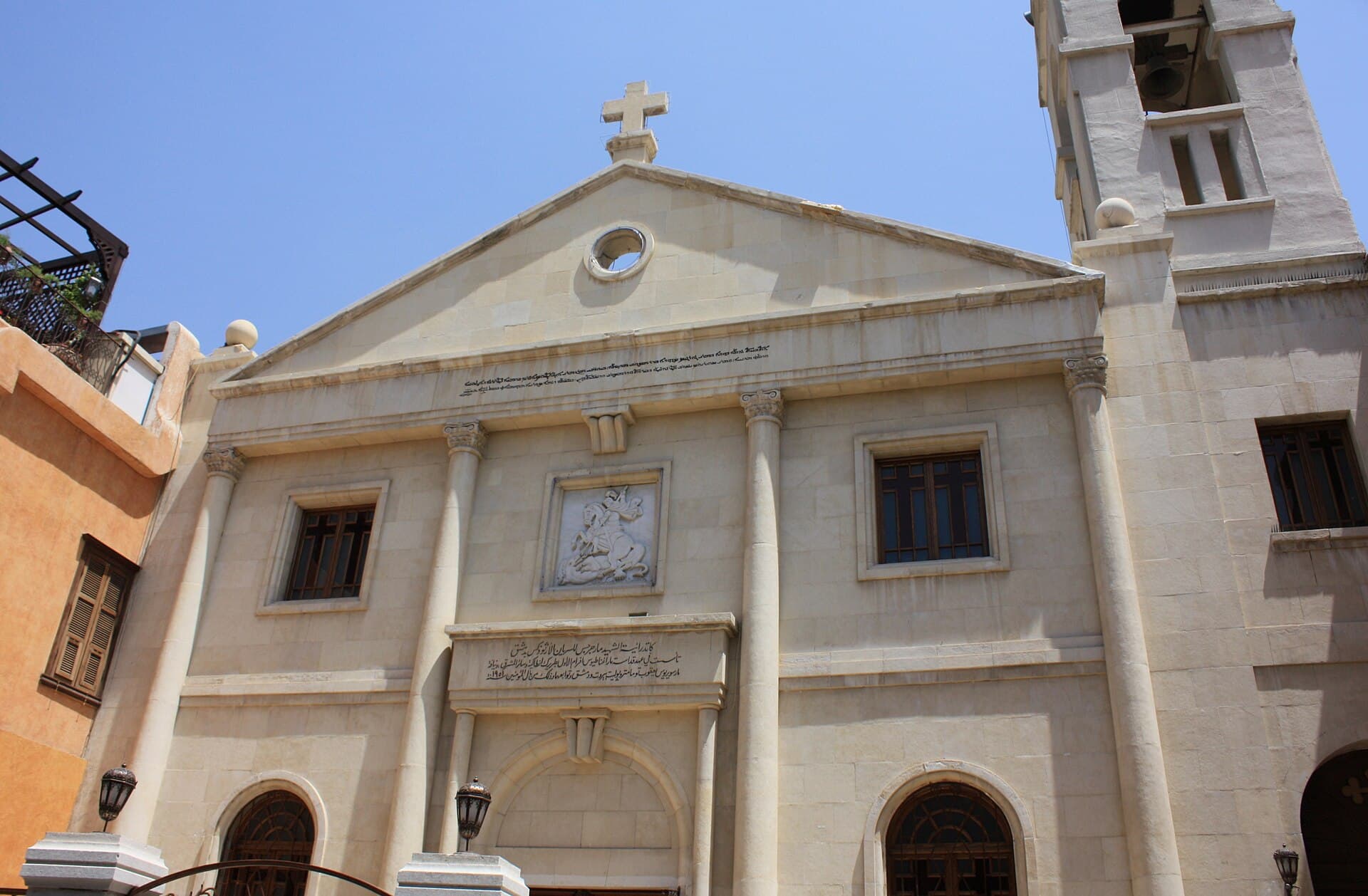
On the east side of Bab Touma Street, a hundred metres or so north of Bab Sharqi Street, a church front faces the traffic: a triangular pediment, four columns, a relief of a saint above the door. This is Saint George’s Cathedral. It is the newest of the churches in the old city — the building was finished in 1951 — yet the patriarchal seat of the Syriac Orthodox Church of Antioch is here.
Getting there
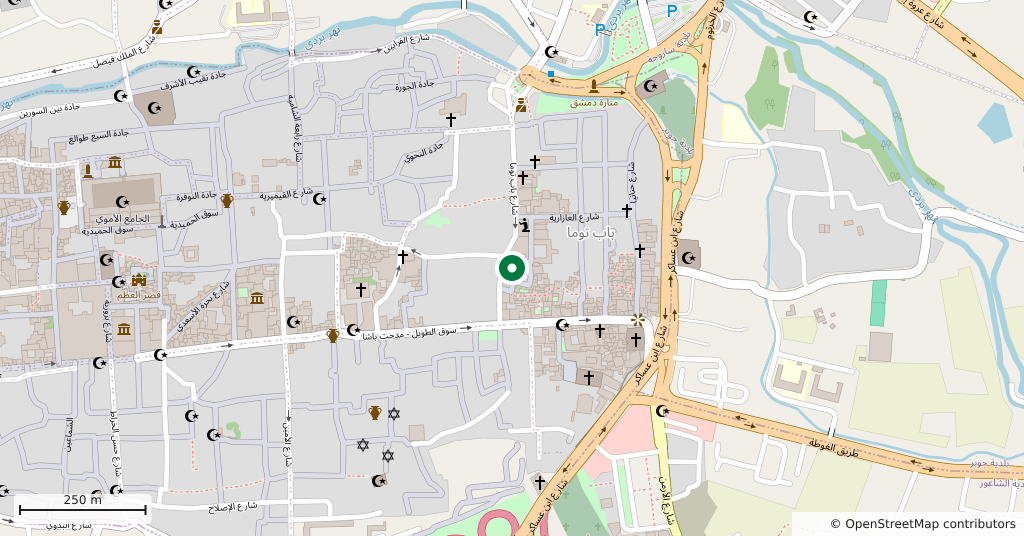
Enter at Bab Sharqi, walk west along Straight Street and turn north at the first large junction. That is Bab Touma Street. The cathedral is a hundred metres along on your right. The front faces the street, so it is hard to walk past; the bell tower stands at the north corner and is fully visible from the opposite pavement.
What to see
The façade follows a classical scheme: two storeys, a triangular pediment, four columns with Corinthian capitals. The relief above the door shows Saint George on horseback, spearing the dragon. A line of Syriac runs under the pediment and an Arabic inscription sits directly above the door, so the building states what it is before you go in. The stone is new and so are the proportions: this was built in 1951, under Patriarch Ignatius Aphrem I Barsoum.
Why the patriarchate sits here
A Syriac Orthodox bishop’s seat existed in Damascus from the 7th century. Ibn Asakir, writing in 1175, mentions an old Syriac church west of Bab Touma, so the community has been in this quarter for a very long time. The patriarchate itself was elsewhere for most of that history. Patriarch Ignatius Jacob III moved it here from Homs in 1959. The seat now belongs to the 123rd patriarch, Ignatius Aphrem II Karim, who spends his summers at Saidnaya, so waiting here for a patriarchal liturgy in August is wasted time. In 2003 the Syriac Orthodox community of Damascus numbered about 25,000.
What not to miss
The patronal feast falls on 6 May. On that day the courtyard and the church are both full, the liturgy is sung in Syriac and Arabic, and the crowd spills onto the street. For the rest of the year the door can look shut, but there is usually someone in the courtyard. Ask before you turn away.
Tips
- The door can look shut while an attendant is in the courtyard; ask
- The relief and the Syriac inscription are on the façade, visible without going in
- The patriarch summers at Saidnaya, so August is the wrong month for a patriarchal liturgy
- Do not photograph during the service; ask afterwards
Transparency
- How this was chosen
- Written by hand; opening hours, entry fee and coordinates are kept as data. A field that is not known for certain is marked as variable rather than guessed.
- Facts checked
- September 2026
- Last updated
- September 15, 2026