Shaqqa (Maximianopolis)
A Roman town on the basalt plateau of the Hauran, raised to city rank in 287. The halls of the Qaysariye, a church of Saint George, a kalybe, and the site today.
- Opening hours
- The remains lie inside the town and can be seen through the day; there is no fixed timetable
- Entry
- Variable — confirm at the entrance
- Duration
- 90 minutes
- Best time
- Morning; the basalt heats up after noon and there is no shade on site
- Period
- Roman — Byzantine
- Address
- Shaqqa, 7 kilometres east of Shahba, As-Suwayda
On the northern edge of the basalt plateau of the Hauran, at 1070 metres, stands a town with Roman Maximianopolis underneath it. Its ancient name was Saccaea, and in 287 it was raised to the rank of a city and took the emperor Maximian’s name. It even kept its own calendar: the years were counted from 286, when Maximian came to the throne. Because it lay in the Roman province of Arabia, the sources set it apart as Maximianopolis in Arabia.
Getting there
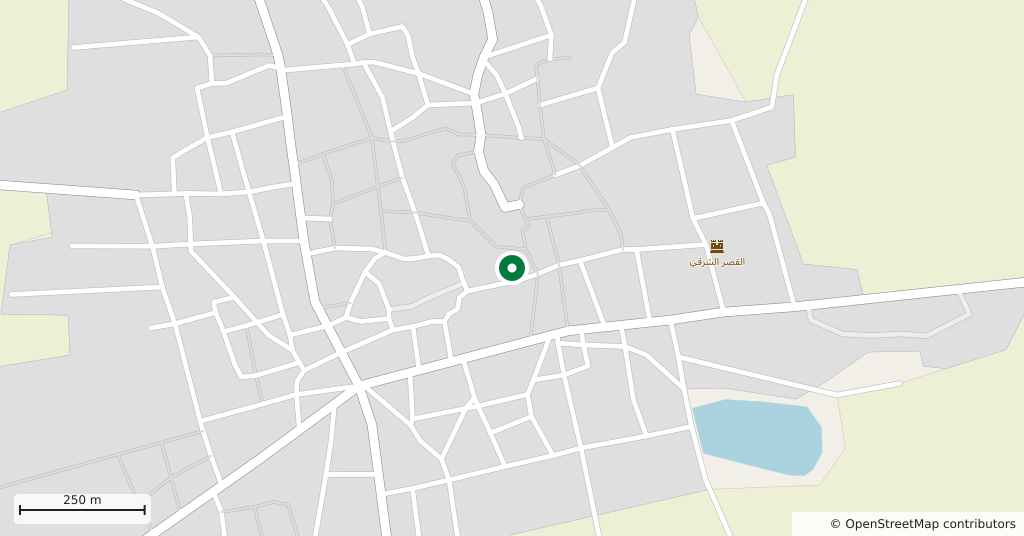
Seven kilometres east of Shahba and 25 kilometres north of As-Suwayda. The remains are not a fenced site; they stand inside the street pattern of the town. You leave the car at the roadside and walk.
How long it takes
An hour and a half. Half an hour at the Qaysariye, half an hour at the old church, the rest at the kalybe and the basalt houses in between.
What to see
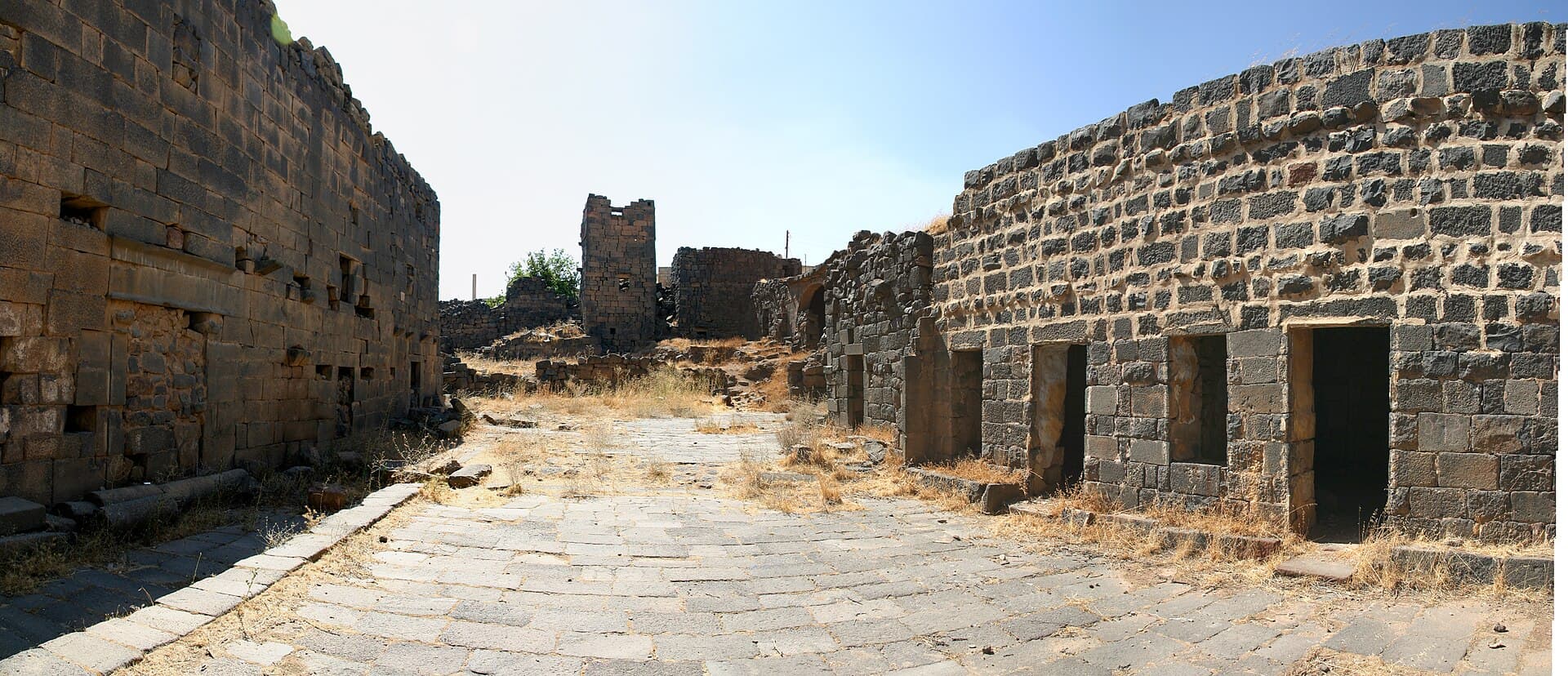
The largest building is the Qaysariye. It was long taken for the residence of the Roman governors; it now reads more like a small forum attached to a wide basilical hall, worked on in the third century. Inside are rooms and halls with foliate carving. The second building is a Roman civil basilica, later converted into a church and dedicated to Saint George. A Greek inscription names the building for the “holy and triumphant” martyr, and the inscription is read as either 368 or 197, which is the ground for the claim that this is the oldest known church dedicated to that saint. The third is the kalybe: a form peculiar to the Hauran, a cult façade open to the air with no enclosed cella behind it.
What not to miss
The inscriptions. One mentions a temple of Zeus Megistos; another carries an epigram about the philosopher Proclus. This was not only a garrison, then, but a town that read and wrote. In 451 the bishop of Maximianopolis, Severus, signed the Council of Chalcedon, and an inscription of 594 records that Bishop Tiberinus put up a martyrium.
Where it stands now
Shaqqa is in Suwayda governorate, which has been inside an armed conflict since July 2025. The present condition of the remains cannot be confirmed from independent sources, and access to the site is not regular. This page tells you what Shaqqa is; it does not tell you that you can go there today.
Tips
- Start at the Qaysariye; the church and the kalybe are within walking distance
- The inscriptions are set over doorways and on lintels — you will miss them if you don't look up
- The town is at 1070 metres, with ice and snow in winter; April and October are easier
- Ancient blocks are built into houses people live in; ask before stepping into a courtyard
Transparency
- How this was chosen
- Written by hand; opening hours, entry fee and coordinates are kept as data. A field that is not known for certain is marked as variable rather than guessed.
- Facts checked
- September 2026
- Last updated
- September 15, 2026