The Roman Temple at Slim (Slaim)
A 2nd-century Roman temple in the village of Slim, on the Damascus–Suwayda road: a three-room plan on a podium and a corner pilaster still carrying its cornice.
- Opening hours
- Open site, daylight hours; current access not confirmed
- Entry
- No known ticket office
- Duration
- 30 minutes
- Best time
- Morning; the east front catches the first light
- Period
- Roman
- Address
- Slim village, Damascus–Suwayda road, Suwayda governorate
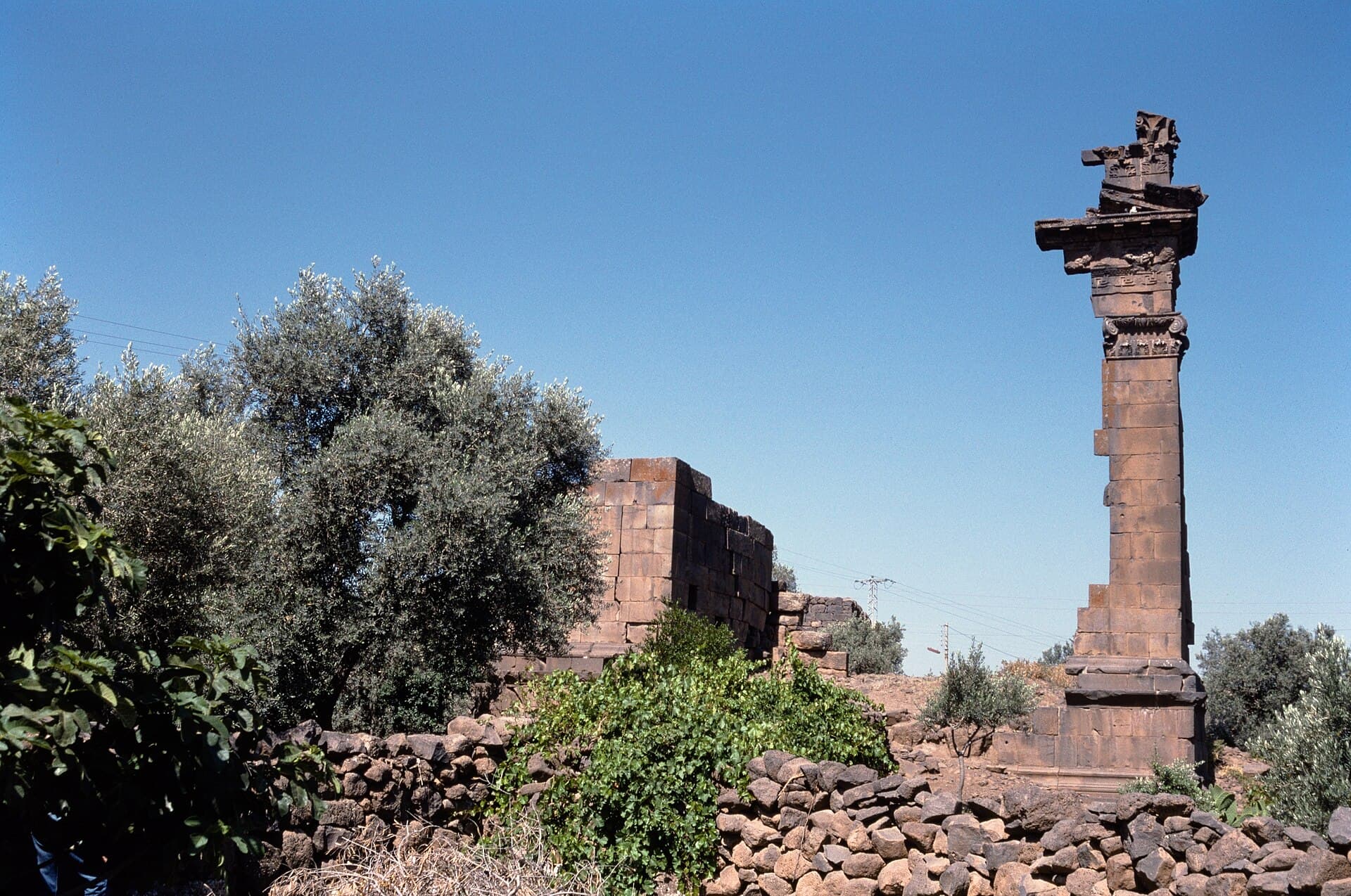
A Roman temple of the 2nd century in the village of Slim, about 10 kilometres north of Suwayda on the Damascus–Suwayda road. The historian Ted Kaizer calls its plan unique and its architectural decoration very rich. In photographs taken for the Dumbarton Oaks archive in 1996, the north-east corner of the east front is still standing: a tall corner pilaster with its capital, entablature and a piece of the pediment on top.
Getting there
The road from Damascus down to Suwayda passes the village. Attil lies to the west of Slim, Shahba to the north and Qanawat to the south-east; the temple at Attil is a few kilometres away. The village is known for its oak woods and for the valley that shares its name.
What to see
The temple is rectangular and sits on a podium close to two and a half metres high. Inside, three rooms follow one another: an entrance porch (pronaos), the main hall (naos) and, at the back, the inner sanctuary (adyton). The photographs show the remains of the east front in detail, with the pilaster capital, the entablature, the pediment and a small turret set into the corner.
Who studied it
The traveller W. J. Bankes was the first to record the temple, in 1819. Howard Crosby Butler, head of the Princeton expedition, examined it in the early 20th century. K. S. Freyberger worked on the building between 1980 and 1988.
What not to miss
Look at the top of the north-east corner. Above the pilaster capital comes the entablature, above that the end of the pediment, and a small turret sits on the corner. Nearly every frame in the Dumbarton Oaks series is aimed at this corner; it is where the building’s ornament reads best.
The village’s name and past
Sources disagree on the ancient name of the village: one gives the Latin Selaema, another Neapolis. In the Ottoman tax register of 1596 it appears as Salam, with 17 households. Druze resettled it in the 18th century, and the Abu Assaf family long held sway there. The traveller Burckhardt wrote that the village sheltered people escaping conscription and taxes. Maqam Abu Rafi’, a Druze shrine, stands in the village.
Where it stands now
Slim is in Suwayda governorate, which has been inside an armed conflict since July 2025. The present condition of the temple cannot be confirmed from independent sources, and access to the region is not regular. This page tells you what the temple at Slim is; it does not tell you that you can go there today.
Tips
- Get close to the north-east corner; the best-preserved ornament is there
- Pair it with the temple at Attil in the same morning; the villages are a few kilometres apart
- The remains sit among village gardens; ask before climbing any wall
Transparency
- How this was chosen
- Written by hand; opening hours, entry fee and coordinates are kept as data. A field that is not known for certain is marked as variable rather than guessed.
- Facts checked
- September 2026
- Last updated
- September 15, 2026