Souq al-Sagha, the Goldsmiths’ Souq of Damascus
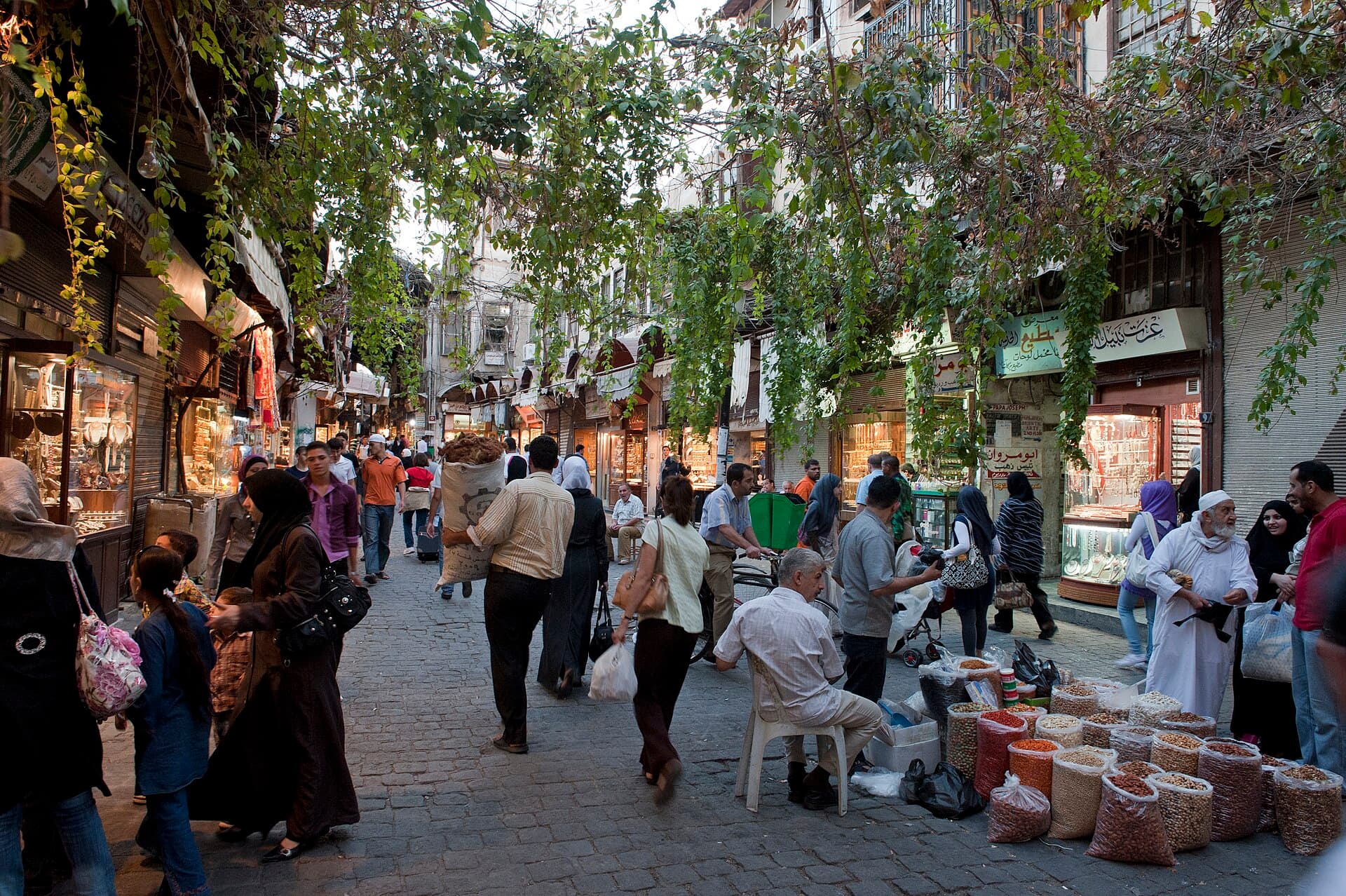
The goldsmiths’ souq opposite the south gate of the Umayyad Mosque: once the shoemakers’ market, half open, half covered, with a few shoe shops still among the gold.
- Opening hours
- Not verified — check shop hours on the spot
- Entry
- Free; the souq is an open passage
- Duration
- 30 minutes
- Best time
- By day, while the shops are open
- Period
- Ayyubid — Mamluk
- Address
- South of the Umayyad Mosque, opposite Bab al-Ziyada, Old City, Damascus
Souq al-Sagha is the goldsmiths’ market of Damascus. It starts directly opposite Bab al-Ziyada, the south gate of the Umayyad Mosque; part of it is open to the sky and part is roofed. The shops sell gold bangles and rings, pearls and jewellery, and the traders sit on large stone platforms. Its old name was Souq al-Qawwafin: a qawwaf sold traditional shoes and wooden clogs. That is why a few shoe shops still stand among the gold windows.
How the goldsmiths got here
The old goldsmiths’ souq stood just to the east, and it burned in a large fire in 1960. The shoe trade was already in decline, and after the fire the goldsmiths moved into this market. Sources count 72 shops here in the past. To the north there is a row of shops, to the east houses, and to the south what remains of Khan al-Safarjalaniyya.
Gold in Damascus before this souq
A goldsmiths’ market first appears in Damascus under the Ayyubids (the dynasty of Saladin), in a separate qaysariyya, a covered market building, on the qibla side of the Umayyad Mosque. In the last Ayyubid years there were two: the old Sagha with the pearl market by Souq al-Haddadin, and the new Sagha in a qaysariyya built in 631 AH, that is 1233-1234, on the qibla side of the coppersmiths’ market. The craft grew under the Mamluks.
Inner and outer Sagha
The Damascus goldsmiths’ association divides the souq in two. Pearls and jewellery are sold in the inner Sagha, bangles and rings in the outer Sagha. Where to start depends on what you are looking for.
What lies under the souq
Historians place the palace of Muawiya, the first Umayyad caliph, in this area. A national excavation team led by Nassib Saliby lifted the platforms over an area of 20 by 9 metres on the souq’s eastern side and dug down. They found foundations set in hard limestone, basalt blocks, pieces of grey granite columns, round basalt millstones and water channels. In 1974 they uncovered a water structure with four openings, which was named the Temple of the Water Nymphs; its pipes were still in place. We do not know whether any of these finds can be seen in the souq today.
Getting there
After visiting the Umayyad Mosque, leave by Bab al-Ziyada, the south gate; the souq is straight across. The northern end of the Al-Bzouriyah Souq and Khan al-Safarjalaniyya are within walking distance.
How long it takes
Half an hour to look around. Shopping changes everything: comparing prices and bargaining easily runs past an hour.
Do not miss
The shoemakers. The few traditional shoe shops squeezed between the gold windows are what still carries the souq’s old name.
Current state not verified
We found no dated source from the past twelve months showing the souq at work. The newest photographs we have date from between 2010 and 2013, and we have not seen damage reports for this part of the Old City. So we give no opening hours: ask on the spot which days and hours the shops are open.
Tips
- Leave the Umayyad Mosque by the south gate; the souq is straight across
- Head to the inner Sagha for pearls and jewellery, the outer Sagha for bangles and rings
- Ask at the start whether the price is by the gram or includes workmanship
- The Al-Bzouriyah Souq and Khan al-Safarjalaniyya are a short walk away; combine them
Transparency
- How this was chosen
- Written by hand; opening hours, entry fee and coordinates are kept as data. A field that is not known for certain is marked as variable rather than guessed.
- Facts checked
- September 2026
- Last updated
- September 15, 2026