Surp Sarkis: the Armenian Cathedral of Damascus
The Armenian Apostolic cathedral sits just inside Bab Sharqi. The domed church you see dates from 1866, entry is free, and the 6 January liturgy fills it.
- Opening hours
- Open at service times; outside them, ask the attendant at the gate
- Entry
- Free
- Duration
- 25 minutes
- Best time
- 6 January for the Armenian Christmas liturgy, or a Sunday morning
- Period
- Ottoman — 1866
- Address
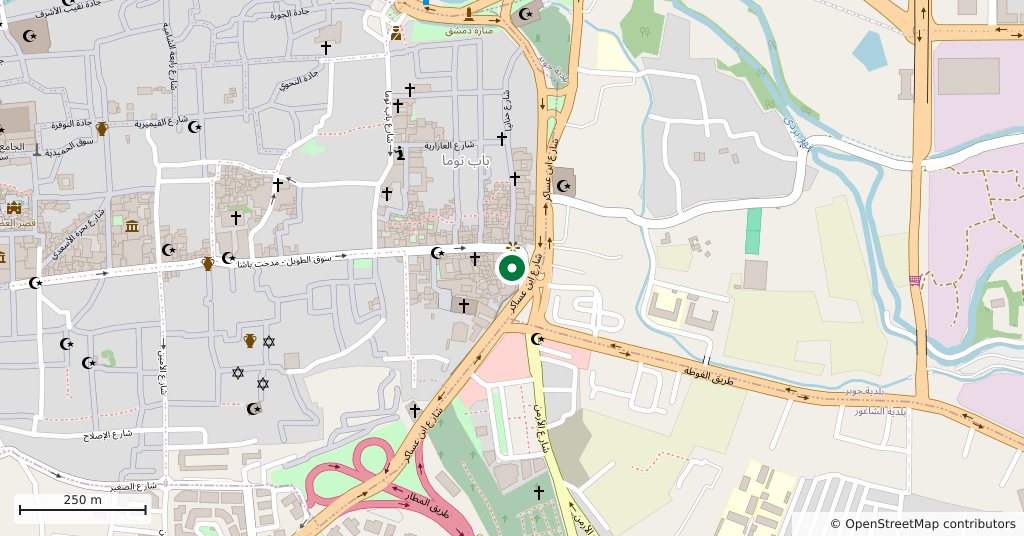
- Straight Street, just inside Bab Sharqi, Old City, Damascus
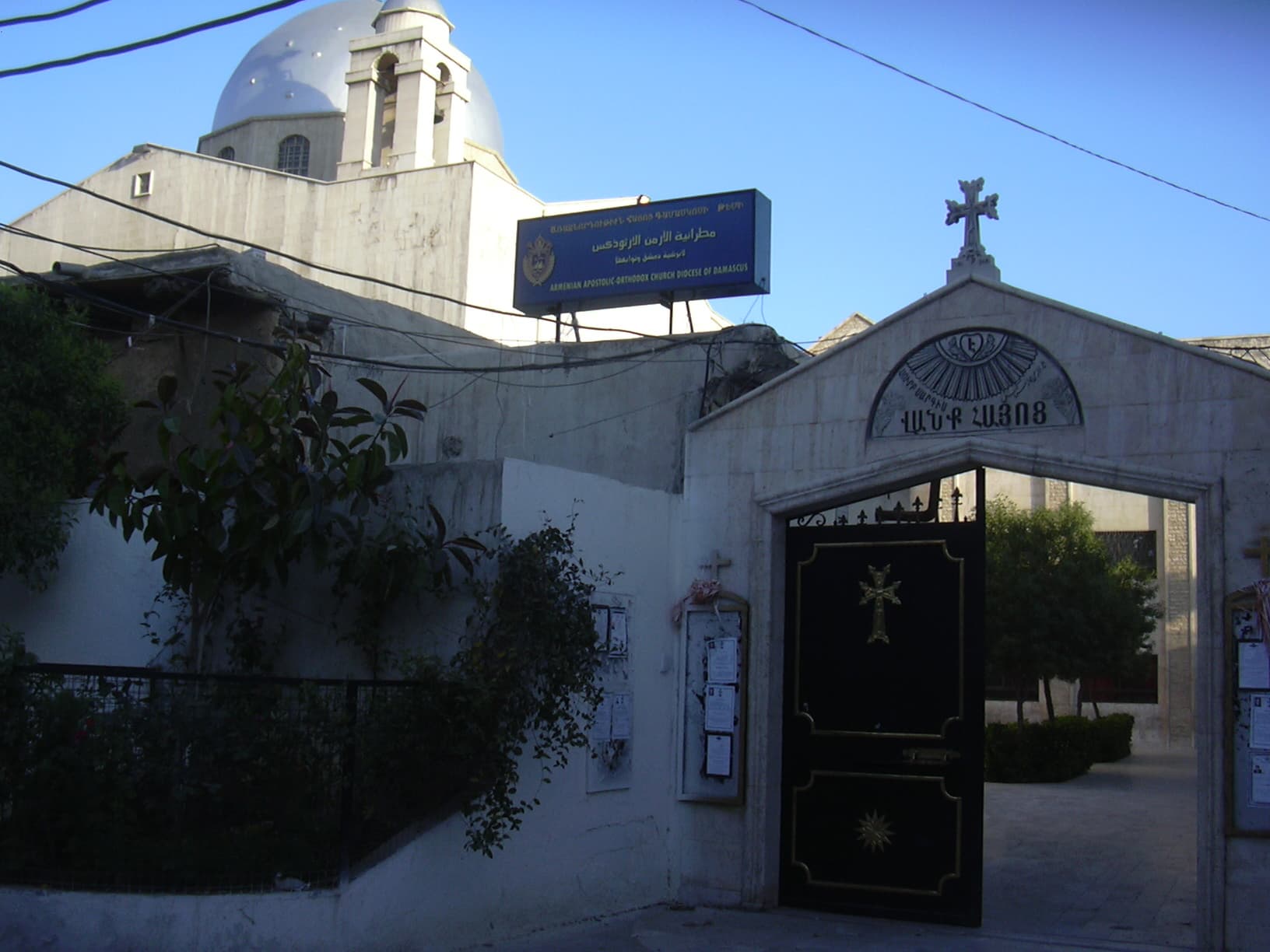
Step through Bab Sharqi and the first courtyard gate on your right belongs to Surp Sarkis. An Armenian inscription runs across its pediment, a carved cross-stone stands on top, two gilt Armenian crosses are set into the gate leaves, and behind them a white dome and a bell gable rise. This is the cathedral of the Armenian Apostolic Church in Damascus and the bishop’s seat as well.
Getting there
Enter Straight Street from the inner face of Bab Sharqi and watch the south side for the first fifty metres. A bilingual sign hangs above the courtyard gate, Arabic and Armenian with English beneath. The gate leads into a courtyard; the church stands at the back of it.
What to see
The church was rebuilt in 1866 with the central dome it has now, and its walls were painted with Sergius and Bacchus, the two soldier saints the church is named after. Stand in the courtyard and look up: the dome is plain white, the bell gable beside it has two tiers, and both carry a cross. The bishop’s residence is not a separate building. It was converted from a medieval caravanserai, so one wing of the courtyard still carries the architecture of a khan, the merchants’ inn built around a yard.
From monastery to cathedral
Before the Arab conquest of 636 a Syriac Orthodox monastery dedicated to Sergius and Bacchus stood on this spot. Under the Mamluks, in the 15th century, Armenians and Syriacs shared the monastery for a time, and it then passed entirely to the Armenians. It was repaired several times through the 17th century and the 18th century. In 1860 it was set on fire during the massacre in the Christian quarter, and six years later, in 1866, it was rebuilt. The dome you see is the work of that rebuilding.
The war years
During the civil war the front line ran 500 metres beyond Bab Sharqi and mortar rounds fell often in the quarter. In November 2013 a mortar hit a minibus carrying pupils leaving the nearby Armenian Holy Translators school, right beside the church; 4 students and the driver were killed, and several more pupils were wounded. Clergy from every denomination in the city attended the ecumenical memorial service held for the children. The church never once suspended its liturgies, and that fact is as concrete as the building itself.
What not to miss
Armenian Christmas falls on 6 January. The church is full that day and the liturgy is sung in Armenian; it is the surest date to hear Armenian sung in Damascus. Look also at the carved cross-stone on the gate pediment. It is called a khachkar, and it is the signature of Armenian building.
Tips
- The gate is immediately inside Bab Sharqi, on the south side of Straight Street
- The courtyard is enough for the dome and the bell gable; you need not enter the church
- The bishop's residence was converted from an old caravanserai; it is the wing that still looks like a khan
- Do not photograph during the service; ask afterwards
Transparency
- How this was chosen
- Written by hand; opening hours, entry fee and coordinates are kept as data. A field that is not known for certain is marked as variable rather than guessed.
- Facts checked
- September 2026
- Last updated
- September 15, 2026