The Syriac Catholic Cathedral of Saint Paul, Damascus
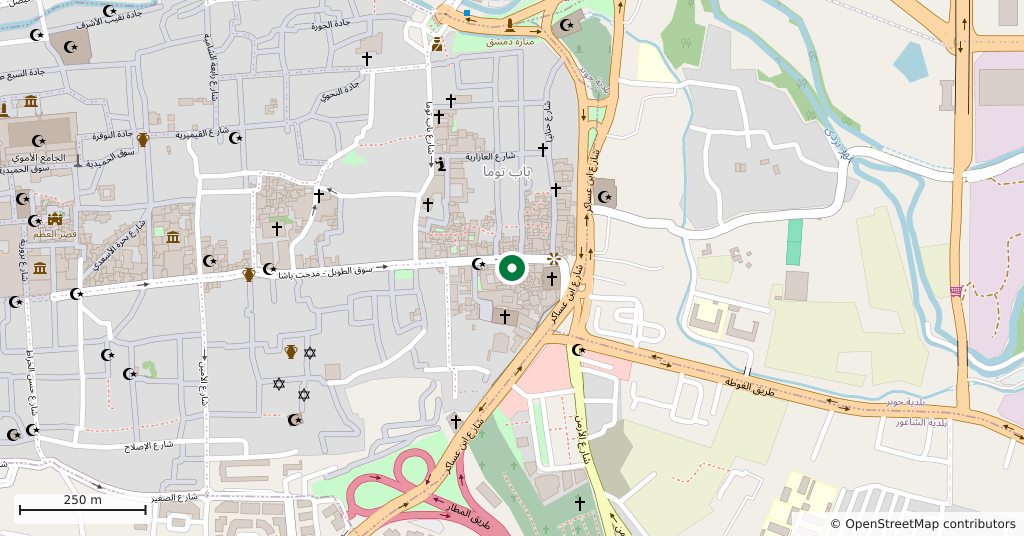
The Syriac Catholic cathedral stands a hundred metres west of Bab Sharqi, on the south side of Straight Street. The present building dates from 1848; entry free.
- Opening hours
- Open at service times; outside them, ask the attendant at the gate
- Entry
- Free
- Duration
- 25 minutes
- Best time
- 29 June for the patronal feast, or Sunday morning during the liturgy
- Period
- Ottoman — 1848
- Address
- Straight Street, west of Bab Sharqi, Old City, Damascus
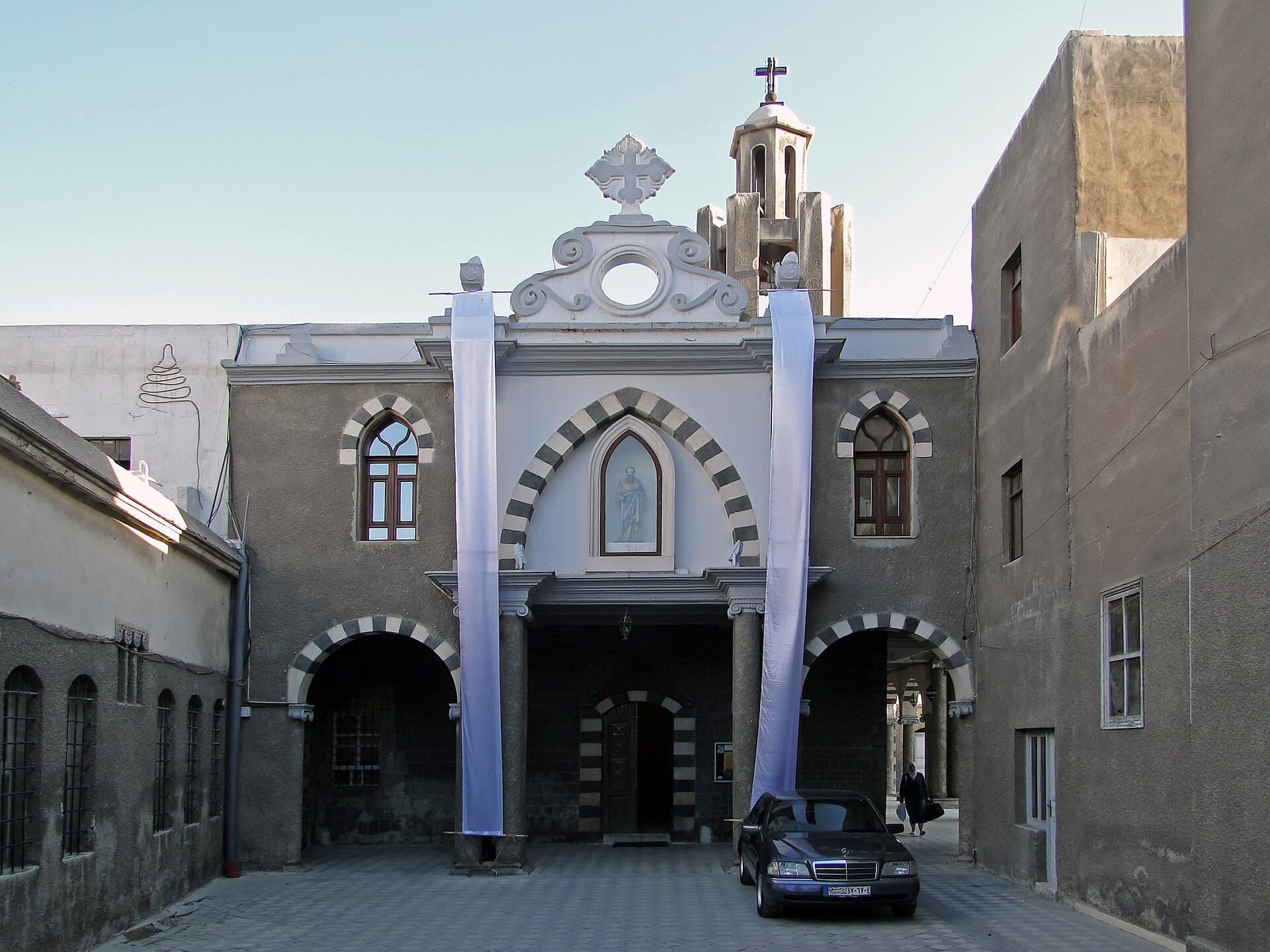
Walk a hundred metres west from Bab Sharqi along Straight Street and a courtyard gate opens on your left, on the south side of the street. Inside is the Syriac Catholic cathedral of Damascus: a portico facing the courtyard, arches banded in black and white, and a statue of Paul in the niche at the centre. This is the seat of the Syriac Catholic archeparchy of Damascus.
Getting there
Enter at Bab Sharqi and walk west along Straight Street; after a hundred metres a narrow courtyard entrance appears on the left. The gate sits back from the street, so it disappears easily among the shopfronts. Surp Sarkis, the Armenian cathedral, stands within the same hundred-metre stretch, and you can see both on one walk.
What to see
Across the courtyard runs a portico of three arches, each coursed in alternating black and white stone. Damascus calls this ablaq, and the mosques of the same quarter use it too. Inside the middle arch, in a pointed niche, stands the statue of Paul. Above the portico is a scrolled pediment topped by a trefoil Syriac cross, and a concrete bell tower rises behind it to the right. The fabric is 19th- and 20th-century work and the columns are concrete; what looks like black basalt from a distance is the banding, not the stone.
How often the church changed hands
A Syriac church dedicated to Moses the Abyssinian stood here first. When part of the community entered union with Rome in 1662, the building itself stayed contested: at times an Orthodox bishop sat here, at times a Catholic one. The Syriac Catholics settled the matter in 1829, and the Syriac Orthodox moved first to the church on Ananias Street and later to Saint George’s Cathedral on Bab Touma Street. The old church came down in 1848 under Bishop Jacob Eliani, the larger cathedral you see went up in its place, and the dedication was changed to the conversion of Paul. In 2006 about 8,000 Syriac Catholics lived in Damascus.
What not to miss
The patronal feast falls on 29 June. Outside service hours the church door can be locked, but the portico is visible from the courtyard, and the attendant at the gate will usually let you in that far. One thing worth knowing: this cathedral is where the story of Saint George’s Cathedral, at the other end of the quarter, begins. Two churches part ways over one building.
Tips
- The gate is on the south side of Straight Street and set back from it; it hides among the shopfronts
- The ablaq portico and the statue of Paul are visible from the courtyard, without going inside
- Surp Sarkis, the Armenian cathedral, is a hundred metres east; the two make one walk
- Do not photograph during the service; ask afterwards
Transparency
- How this was chosen
- Written by hand; opening hours, entry fee and coordinates are kept as data. A field that is not known for certain is marked as variable rather than guessed.
- Facts checked
- September 2026
- Last updated
- September 15, 2026