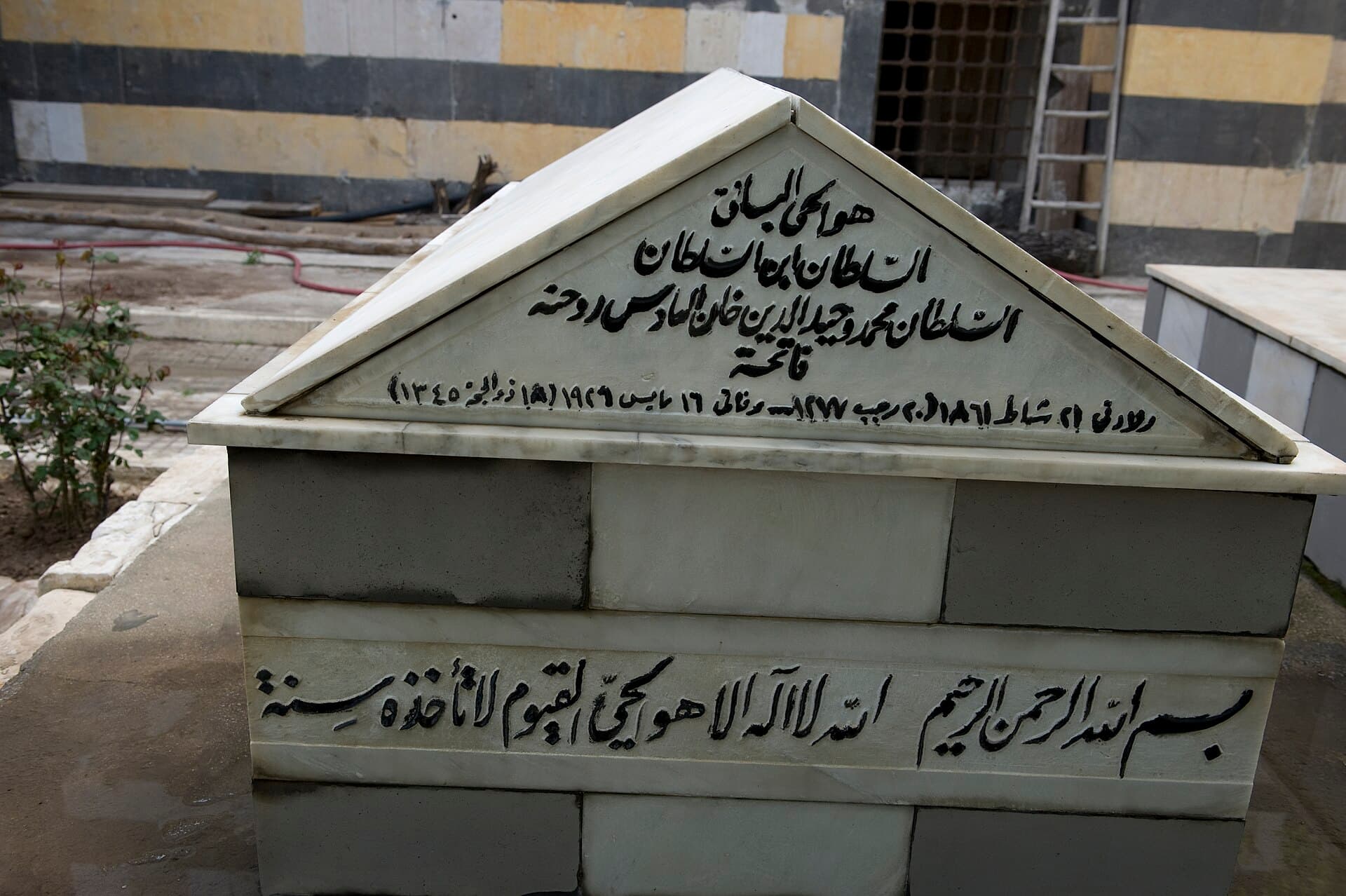
Tomb of Mehmed VI, the Last Ottoman Sultan, in Damascus
Mehmed VI Vahideddin, the last Ottoman sultan, lies in the cemetery of the Takiyya al-Sulaymaniyya in Damascus. Why he was buried here and what the grave shows.
- Opening hours
- Variable — the Takiyya opens in daytime; confirm access to the cemetery on site
- Entry
- Variable — confirm at the entrance
- Duration
- 30 minutes
- Best time
- Morning, while the courtyard is in shade and the garden is quiet
- Period
- Post-Ottoman — buried 1926
- Address
- Cemetery of the Takiyya al-Sulaymaniyya, on the Barada beside the National Museum, Damascus
The grave of Mehmed VI Vahideddin, the last Ottoman sultan, lies in Damascus, in the cemetery of the Takiyya al-Sulaymaniyya — the complex his ancestor Suleiman the Magnificent built on the Barada. It is a plain marble sarcophagus with a gabled top. Thirty other members of the Ottoman dynasty are buried in the same shaded garden.
Why the last sultan is buried in Damascus
The sultanate was abolished in 1922 and Mehmed VI left the country. He stayed for a while in the Hijaz, then moved to Italy, and died in Sanremo on 16 May 1926. He had asked to be buried in Mecca or on Turkish soil; Turkey refused to accept the body. A Muslim land was sought instead, and the choice fell on the complex his ancestor Suleiman had built in Damascus. France, which held Syria under its mandate, gave permission. The coffin was brought to Damascus by way of Beirut and buried in the courtyard of the Takiyya on 3 July 1926, while street fighting from the Great Syrian Revolt went on in the city.
The funeral and after
Members of the Mevlevi, Qadiri and Rifa’i Sufi orders attended the funeral, along with Turkish civil servants and officers still in Damascus and Syrian notables. Among them was Damat Ahmed Nami, head of the State of Syria and himself married into the Ottoman family. At first the grave was only a mound of earth. His daughter Sabiha Sultan and her husband Ömer Faruk asked the Syrian government to build a mausoleum. Bureaucracy and political turmoil prevented it, and the compromise was a simple marble sarcophagus. In later years thirty more members of the dynasty were buried in the same courtyard.
What to see
The cemetery is a small garden at the foot of the Takiyya’s pencil minarets and dome, shaded by trees and covered by an iron pergola. Most of the graves are fenced with iron railings. Mehmed VI’s sarcophagus is built of white and grey marble blocks and closes at the top like a pitched roof. The gable carries his name and date of death in Arabic script; the long side bears the basmala and the opening line of the Throne Verse from the Quran. Behind it rises the Takiyya’s wall in yellow, black and white stripes of stone. Captions on Commons photographs from 2009 name Refia Sultan, Fehime Sultan and Nazime Sultan among the graves nearby, and a photograph dated 2022 shows Refia Sultan’s grave in place.
What state it is in today
On 24 December 2024 Burhan Köroğlu, Turkey’s acting chargé d’affaires in Damascus, announced that the grave would be restored. We found no dated source showing whether the work has started or finished, so the grave may look different from the photograph today. The Takiyya is a complex open in daytime, but whether the cemetery is open to visitors, and when, should be confirmed at the entrance.
Getting there and how long it takes
The Takiyya al-Sulaymaniyya is on the Barada, west of the Old City, on the same block as the National Museum, within walking distance of the centre. Half an hour is enough for the cemetery. With the complex’s courtyard and the crafts market under its arcades, the visit runs a little over an hour.
Don’t miss
The link between where the grave lies and the history of the complex. The Takiyya was completed in 1560 on Suleiman’s orders; the last sultan was buried in its courtyard in 1926. That was the reason the body came here: a ruler refused entry to Turkey was laid in the shadow of a building his ancestor had raised. Look up from the sarcophagus to the pencil minarets and both dates are in the same view.
Tips
- The cemetery is inside the complex; ask the attendant at the Takiyya for its gate
- In the Arabic inscription on the gable, the date 1926 is the easiest line to pick out
- The Takiyya and the National Museum share a block, so both fit into half a day with the cemetery
Transparency
- How this was chosen
- Written by hand; opening hours, entry fee and coordinates are kept as data. A field that is not known for certain is marked as variable rather than guessed.
- Facts checked
- September 2026
- Last updated
- September 15, 2026