The Walls of Damascus
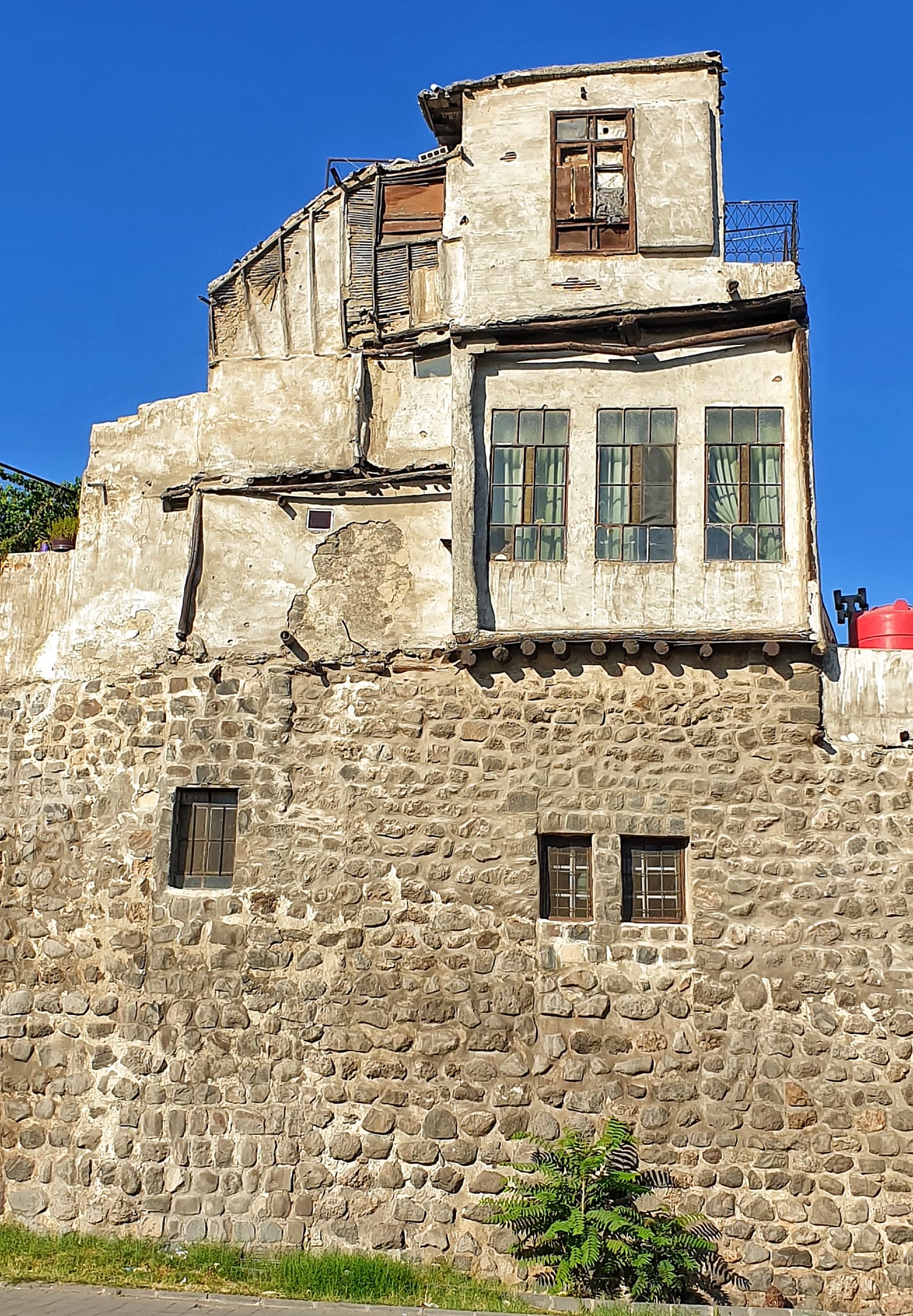
The wall around the old city encloses some 100 hectares. Its courses read period by period: reused blocks below, Nur al-Din above, Ottoman at the top.
- Opening hours
- Open; the line of the wall is followed from the street
- Entry
- Free
- Duration
- 120 minutes
- Best time
- Morning, when side light separates the courses
- Period
- Roman — Zangid — Ayyubid — Mamluk — Ottoman
- Address
- The old city wall, Damascus
The eight gates of Damascus are visited one by one; what joins them is the wall itself. It encircles the old city in a rectangle of roughly 1500 by 750 metres, holding about 100 hectares. The grid of streets inside survives from the Roman fabric, so the boundary the wall draws also holds the plan of the city.
How the gates are counted
The Roman wall had seven gates: Bab al-Salam, Bab Sharqi, Bab Touma, Bab al-Faradis, Bab al-Jabiya, Bab al-Saghir and Bab Kisan. Bab al-Faraj, added in the Islamic period, is the eighth. The eight are not in the same condition. Some now work as market arches, others stand free.
How to read the stone
The most instructive thing about the wall is its courses. The large blocks at the bottom are reused from the older wall that predates the 12th century; the courses above them are from the time of Nur al-Din Zangi; the undressed blocks at the very top are Ottoman. You can stand at one stretch of wall and see three periods in a single frame, and all you have to do is look up.
Where to walk it
In the north the line follows the bed of the Barada. Between the citadel and Bab al-Jabiya the passage called Bayn al-Surayn, between the two walls, can still be walked; its name comes from the gap left between two parallel walls. Two towers on the wall matter: Burj Nur al-Din and Burj al-Salih Ayyub. Burj Nur al-Din stands at the southwest of the line, south of the Sinan Pasha Mosque, and is 10 metres high.
What most people miss
Look at the houses built on top of the wall. Along the southeastern stretch there are dwellings sitting directly on the stone courses: small windows cut into the wall at the lower level, and above them an overhanging upper storey on wooden beams. Here the wall is not a museum piece but a wall. The city did not abandon it; it sat down on it.
Tips
- Read the courses from the top down; three periods sit on one another
- Walk the Bayn al-Surayn passage between the citadel and Bab al-Jabiya
- Houses stand on top of the wall along the southeastern stretch
- Do not try to finish the whole circuit in one go; pick two gates
Transparency
- How this was chosen
- Written by hand; opening hours, entry fee and coordinates are kept as data. A field that is not known for certain is marked as variable rather than guessed.
- Facts checked
- September 2026
- Last updated
- September 15, 2026