Al-Qaiqan Mosque, Aleppo
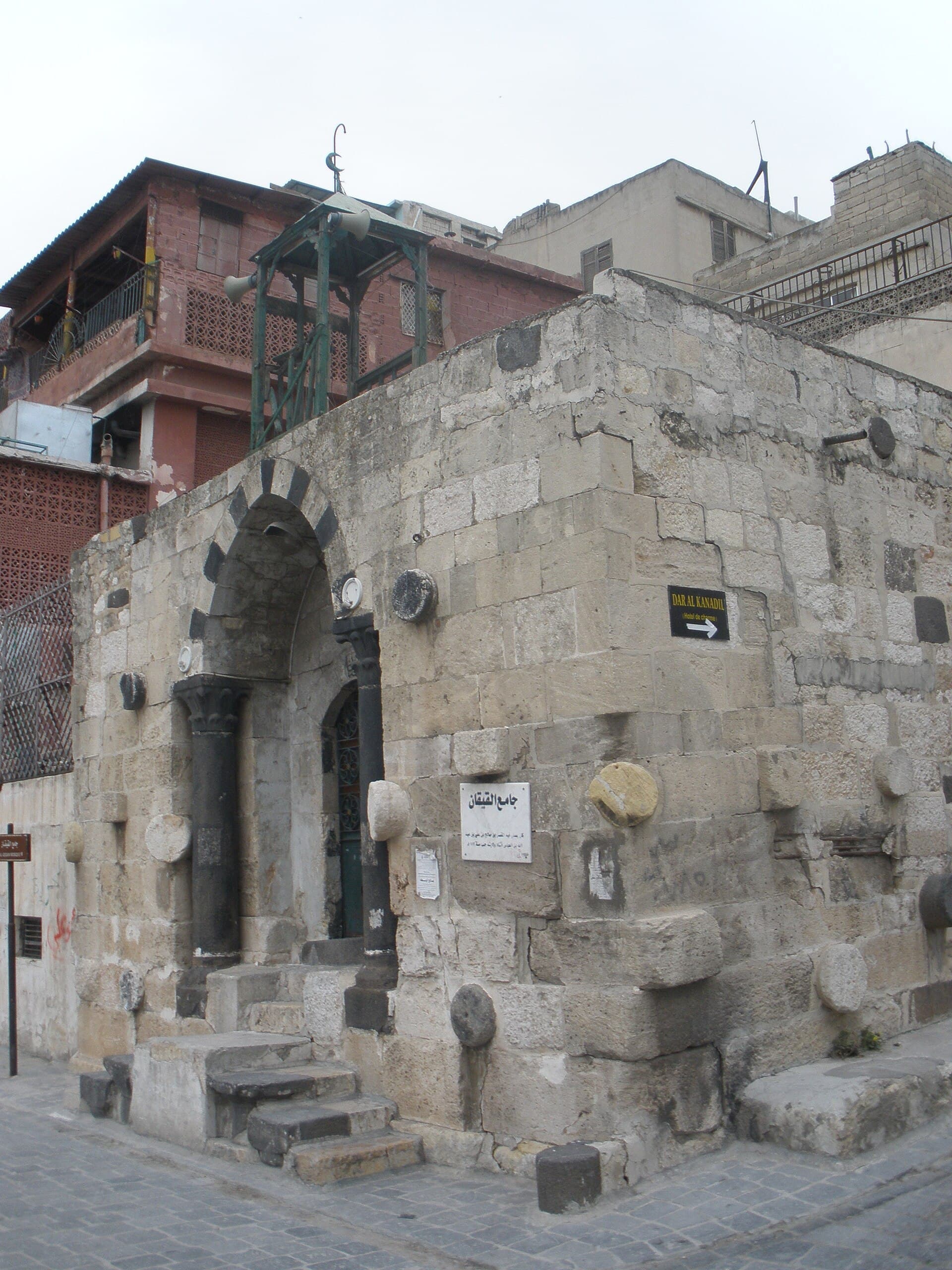
A small mosque 100 metres north of Bab Antakya in Aleppo. Ancient columns sawn across are set into its walls, and one block carries Hittite hieroglyphs.
- Opening hours
- Daylight hours, outside prayer times
- Entry
- Free
- Duration
- 20 minutes
- Best time
- Afternoon, when the south wall takes the light from the side
- Period
- Mamluk — built with reused ancient stone
- Address
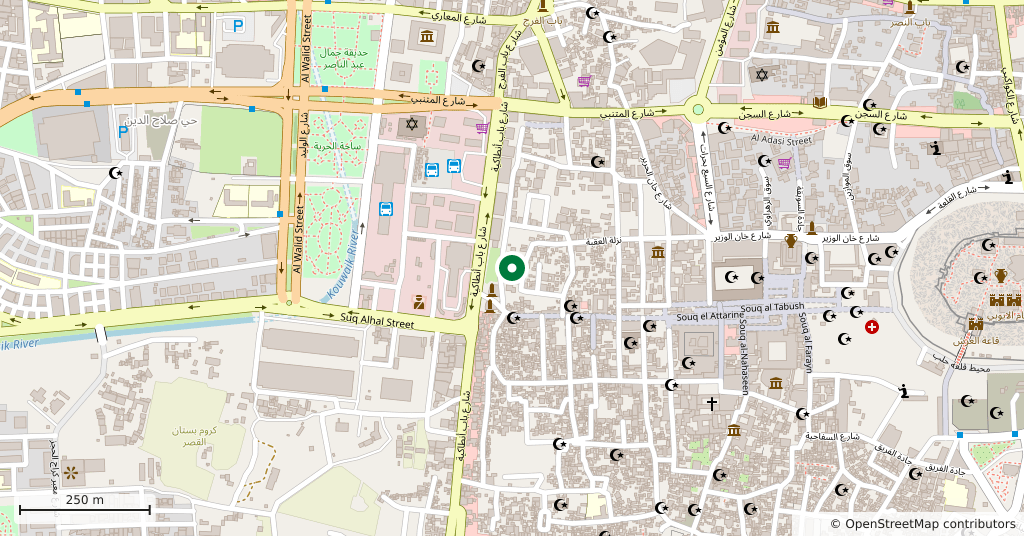
- Al-Jalloum quarter, north of Bab Antakya, Old City, Aleppo
One of the smallest historic mosques inside the walls of Aleppo, and probably the one with the strangest walls. From outside the building is plain; the stones are the point. Columns taken from much older buildings were sawn across and laid into the masonry, so their round cross-sections face the street. The name comes from the Arabic word for crow.
Getting there
100 metres north of Bab Antakya, the western gate into the walled city. Once through the gate, turn left before the souq and walk up the slope. The mosque stands on a street corner a few steps above the pavement, its Arabic name on a white plaque fixed to the wall. This is the al-Jalloum quarter, the same slope as the Behramiyah Mosque.
How long it takes
20 minutes. There is a single prayer hall, and most of that time goes on the outside walls rather than the interior. Arrive at prayer time and you may have to wait for the door.
What to see
Two black basalt columns flank the door. They are centuries older than the mosque; the capitals are carved, the shafts worn smooth by hands. Above them a pointed arch is built in alternating courses of black and white stone. Then look at the walls. On every face, at every height, dozens of round stone bosses push out of the masonry. Each one is an ancient column sawn across. They are building material, not ornament — whoever raised this mosque used what the ruins nearby had left.
How old the building is
The site is said to have carried a Hittite temple in antiquity, and the stones in the wall support the claim, though the building itself is far younger. Its use as a mosque is traced back to the 12th century, and it took its present shape under the Mamluks, the sultanate that ruled Syria and Egypt in the later Middle Ages. It was enlarged in 1965 and fully restored in 1996, which is why the interior looks tidier than the outside promises.
What not to miss
On the south wall, at eye level, a dark block sits framed in mortar. The signs cut into it are Anatolian hieroglyphs of the 13th century BC — roughly 2000 years older than the mosque around them. The inscription names Telipinu and Talmi-Sharruma, kings of Aleppo and descendants of the Hittite king Suppiluliuma I. Most visitors photograph the doorway and leave.
Tips
- The door is a few steps above the street, between two black basalt columns
- The round bosses in the walls are ancient columns sawn across; all four faces have them
- The hieroglyphic block is on the south wall at eye level, framed in mortar
- Come up the slope from Bab Antakya and the mosque is on your right
Transparency
- How this was chosen
- Written by hand; opening hours, entry fee and coordinates are kept as data. A field that is not known for certain is marked as variable rather than guessed.
- Facts checked
- September 2026
- Last updated
- September 15, 2026