The Armenian Catholic Cathedral of Aleppo
The cathedral and archbishop’s seat of Aleppo’s Armenian Catholics. A mansion bought in 1831 became a church by 1840; wrecked in 2015, reopened in 2019.
- Opening hours
- Open at service times; otherwise ask at the courtyard gate
- Entry
- Free
- Duration
- 35 minutes
- Best time
- Sunday morning as the service ends; the church is open and the yard full
- Period
- Ottoman
- Address
- Tilal Street, Aziziyah, Aleppo
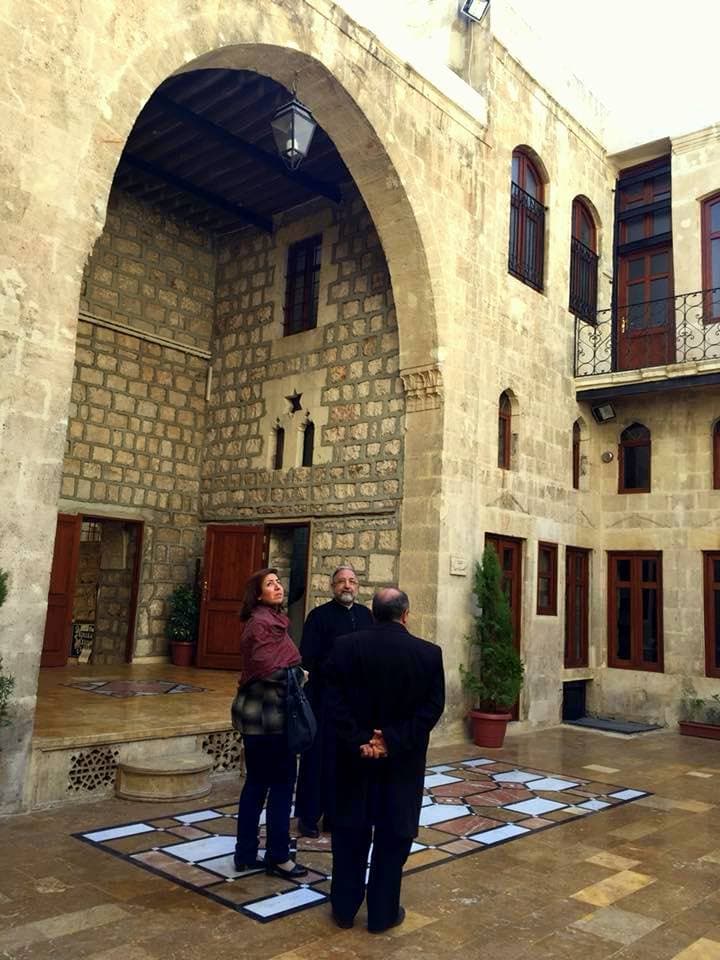
It stands on Tilal Street, where Aziziyah meets Jdeideh. This is the cathedral of Aleppo’s Armenian Catholics and the seat of their archbishop; its full name is Our Mother of Reliefs. It was never built as a church. Bishop Ibrahim Kupelian bought a large courtyard house here in 1831, and the conversion ran until 1840. Step into the yard and you can still read that history in the walls.
Getting there
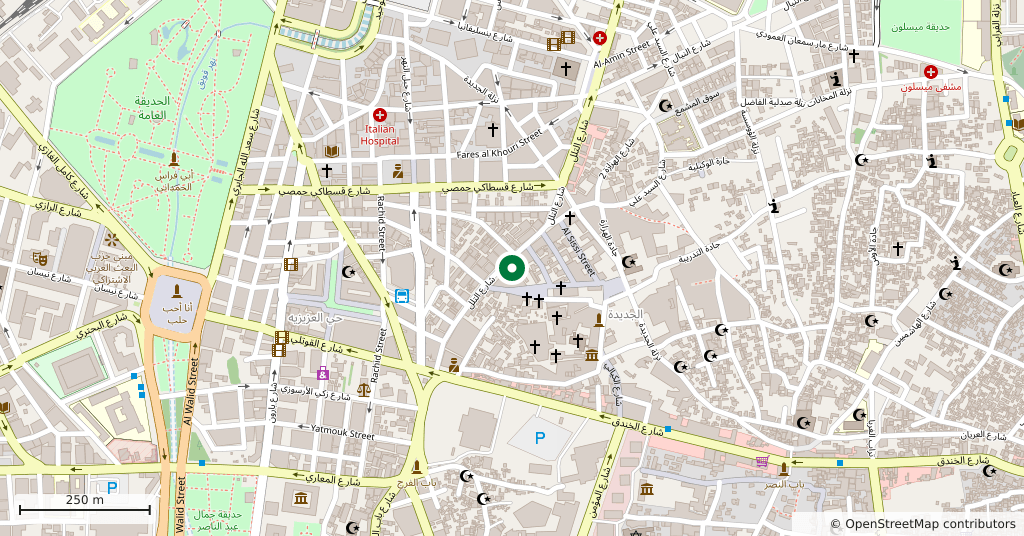
Walk about a hundred metres west of Farhat Square. The Maronite Cathedral, the Forty Martyrs and the church courtyard of Jdeideh all sit on the same short walk.
How long it takes
Half an hour is enough. The church is not large and most of your time goes in the yard. If a service is on, allow an hour: the liturgy is sung in Armenian.
What to see
What you see today is the sum of three separate campaigns. A new entrance was built in 1910, and the enlargement between 1963 and 1966 gave the nave its present size. In the yard stands a memorial stone raised in 1993 for the Armenians killed in 1915. The archbishop’s residence adjoins the cathedral, and the same compound holds the Sardarabad hall, which seats 600, and the Mar Grigorius school. Marianist monks founded that school in 1907 and it became a secondary school in 1956.
Don’t miss
The yard itself. Stop for a few minutes before you go in. The two-storey front, the arched passage and the stone paving belong to an Aleppine merchant house; the church settled around this courtyard afterwards. Once you have seen churches in the city that were built as churches, the difference is obvious.
How it stands now
The church was looted in the Aleppo uprising of 1850, but it survived the fire that swept the city. The second blow came on 9 January 2015, when shelling destroyed 65 per cent of the building. Restoration finished in December 2019 and the cathedral reopened that month; the cost was shared by two Syrian associations and by Armenian Catholic dioceses in Italy and Germany.
Tips
- The courtyard gate may look locked; ask at the archbishop's residence beside it
- The memorial stone is in the yard, so you will walk past it if you head straight inside
- The service is in Armenian; ask at the door for the starting time if you want to follow it
- The Maronite Cathedral is a hundred metres east, and the two make one walk
Transparency
- How this was chosen
- Written by hand; opening hours, entry fee and coordinates are kept as data. A field that is not known for certain is marked as variable rather than guessed.
- Facts checked
- September 2026
- Last updated
- September 15, 2026