Ba’uda, a Dead City of Shops on Jebel Barisha
On Jebel Barisha above Bab al-Hawa, a market town of two-storey porticoed houses, shops below and homes above, and a church dated 392. Not the Jebel Zawiya one.
- Opening hours
- Open site, daylight hours
- Entry
- Variable — confirm on arrival
- Duration
- 45 minutes
- Best time
- Spring and autumn, before the summer heat
- Period
- Byzantine
- Address
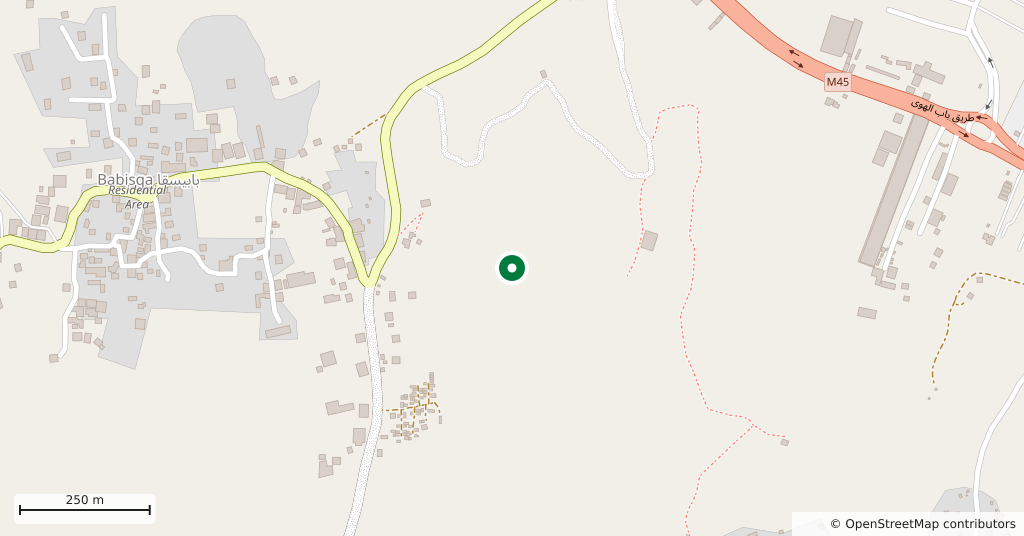
- Northern slope of Jebel Barisha, south of Bab al-Hawa, Dana subdistrict, Idlib
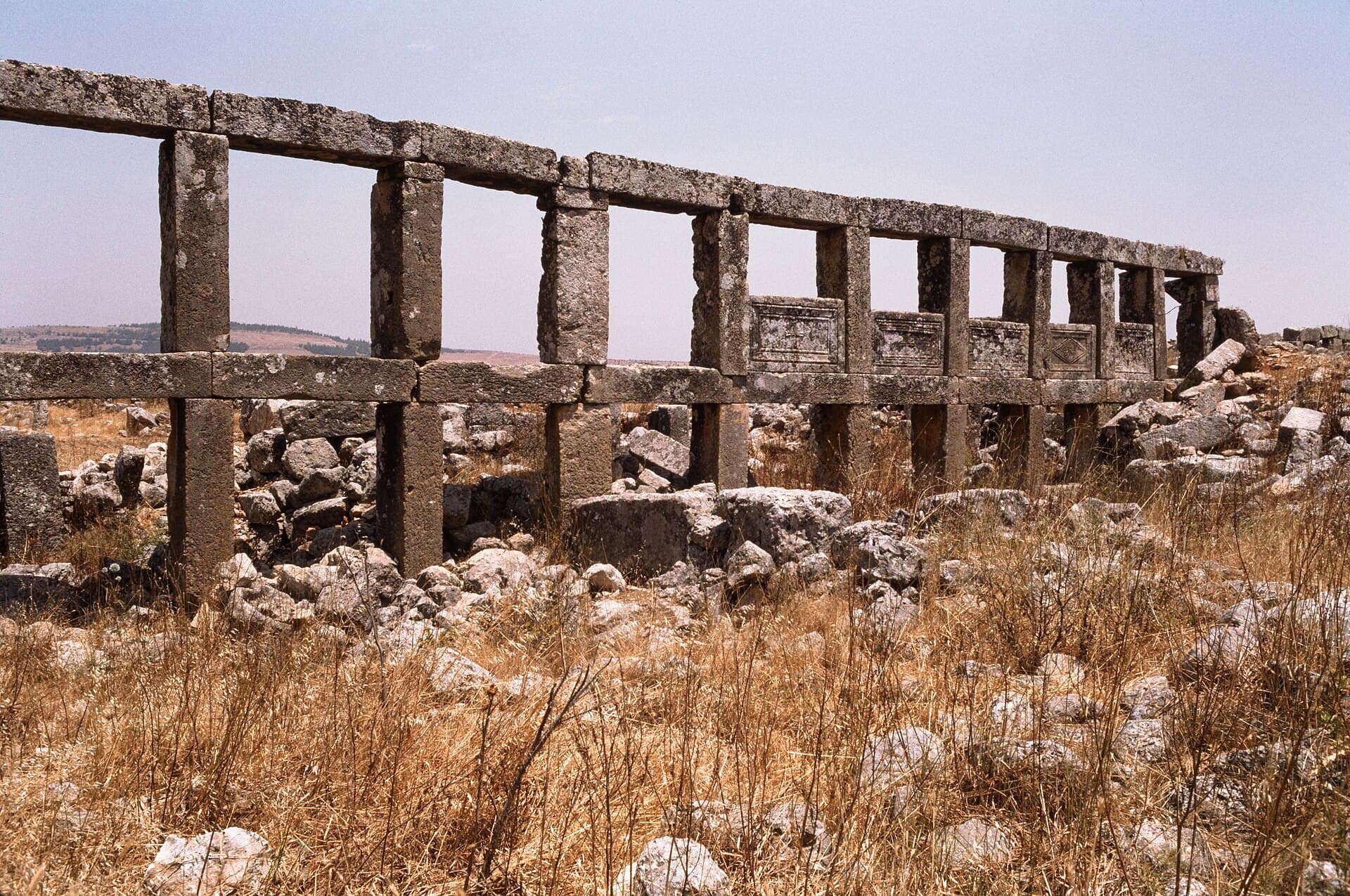
A small market town on the northern slope of Jebel Barisha, looking down on the Bab al-Hawa crossing. What sets Ba’uda apart from the other Dead Cities is its shops. The houses stand in full rows, fronted by two-storey porticoes on piers: shops below, living quarters above. Most of the houses date from the 4th century, and the town was at its height in the 5th and 6th centuries. There is also a church dated 392, whose inscription was set into the wall upside down.
The name causes confusion. A second Ba’uda, known for its pyramid tomb, lies on Jebel Zawiya between Al-Bara and Serjilla. This page is about the one on Jebel Barisha, just south of Bab al-Hawa.
Getting there
North of Idlib, in the Dana subdistrict. From the ruins you can see the Bab al-Hawa crossing 2 kilometres below. Babisqa is 2 kilometres south, Ksejbe about a kilometre south-east, and Dar Qita nearly three kilometres west. There is no public transport; you hire a car and driver in Idlib or Sarmada. Nothing is signposted. This slope is very close to the border, so talk through the state of the road with your driver before setting out.
How long it takes
Forty-five minutes. The town is small. Babisqa and Ksejbe fit into the same morning.
What you see
The porticoed houses. Stone piers run up two storeys along the fronts. The openings on the ground floor were shops, and the family lived upstairs. Limestone parapet slabs were fitted between the piers of the upper storey, and some are still in place. One slab carries a cross in relief, and another cross is carved inside a medallion on the portico.
The church. When Howard Crosby Butler arrived in 1905, the small church was almost entirely in ruins; he dated it to 392 from its inscription. The nave is nearly square, with three columns in each arcade. The only doors are in the south wall, two of them, opening onto a walled courtyard. The capitals are Tuscan and Ionic. The east doorway gives the architect’s name: Markianos Kyris.
With Barisha, Baqirha and Dar Qita, the town was one of the centres of the mountain’s trade in olive oil and wine. The row of shops shows how that trade worked at village level.
The upside-down inscription
The church’s Greek inscription was laid into the wall upside down. The mason who set the stone clearly could not read it. The date survived all the same: 392. That year places Ba’uda among the early dated churches of Jebel Barisha. Georges Tchalenko made rough surveys of the site in 1941 and 1970.
How it stands today
There is a modern farm settlement 300 metres south-west of the ruins. Its ancient buildings are used as stalls for goats and geese. During the war years, displaced families took shelter in the Dead Cities of Jebel Barisha. We found no verified record of the buildings’ present condition; do not walk into the farmyard without asking.
Don’t miss
The parapet slabs of the upper storey. Most visitors look at the row of piers from a distance and move on. Up close you can make out the framed faces of the slabs and the relief cross. This two-storey arrangement is also the clearest sign that the town was a row of shops.
Tips
- It is easily confused with its namesake on Jebel Zawiya; ask the driver for the Ba'uda near Bab al-Hawa
- Look closely at the parapet slabs; one carries a relief cross
- The farm to the south-west uses ancient buildings as stalls; do not enter the yard without asking
- Babisqa is 2 kilometres south; put the two in one morning
Transparency
- How this was chosen
- Written by hand; opening hours, entry fee and coordinates are kept as data. A field that is not known for certain is marked as variable rather than guessed.
- Facts checked
- September 2026
- Last updated
- September 15, 2026