Birket al-Hajj, the Pilgrims’ Pool of Bosra
The great reservoir that watered Bosra’s pilgrim caravans: stone walls nearly 150 metres long, an Ayyubid repair, a madrasa on its edge and the 2018 flood.
- Opening hours
- Open-air site; no fixed timetable could be confirmed
- Entry
- Variable — confirm on the spot
- Duration
- 20 minutes
- Best time
- Late afternoon, when light from the west falls on the buildings along the north side
- Period
- Nabataean — Roman — Ayyubid
- Address
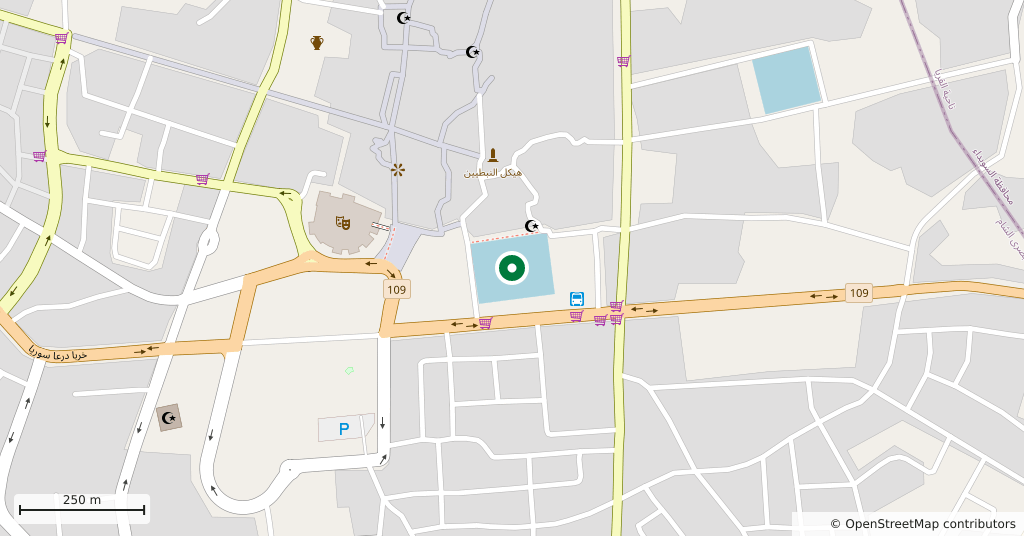
- East of the theatre, south-east corner of the ancient city, Bosra
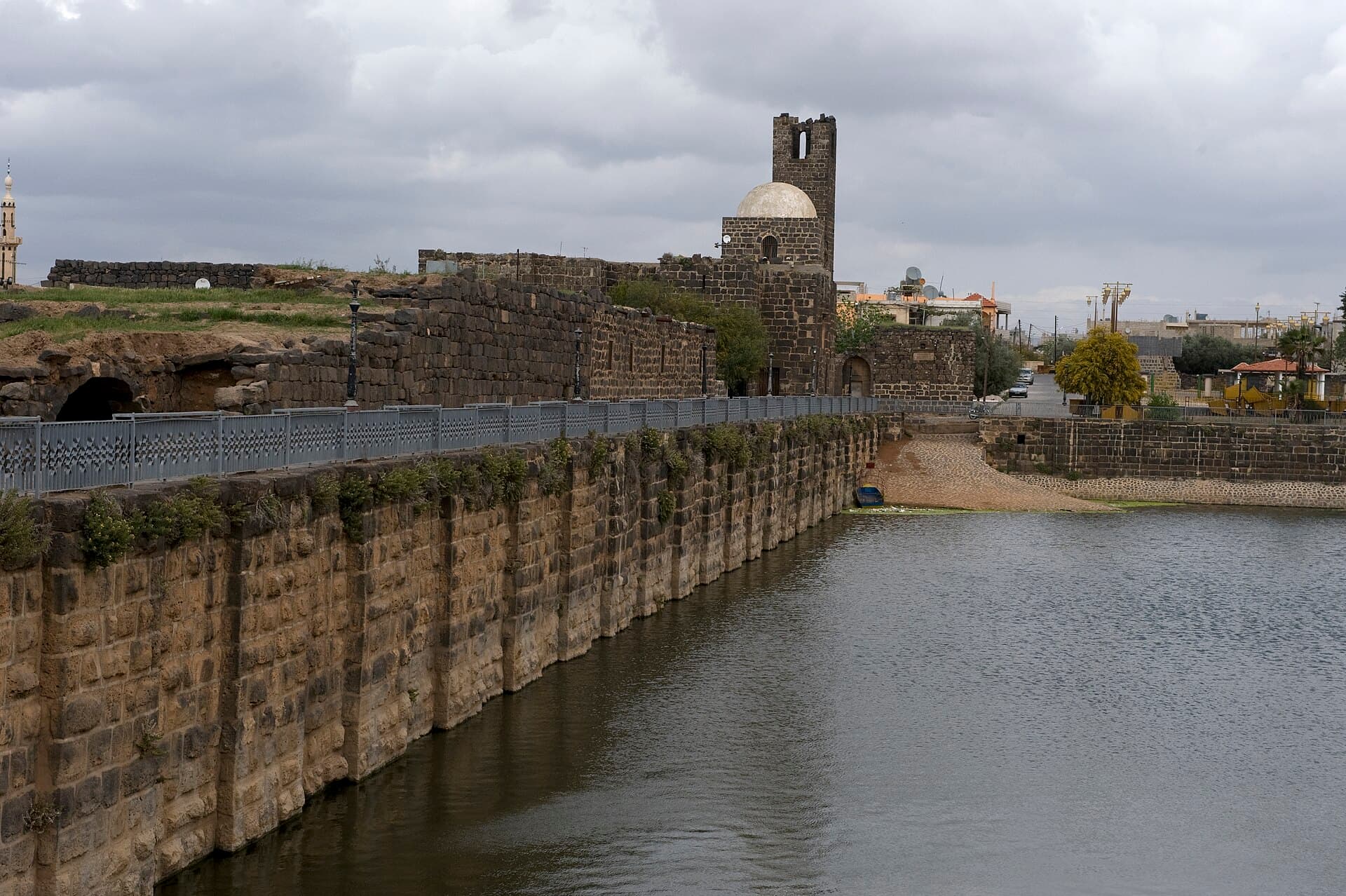
East of the theatre, in the south-east corner of the ancient city, lies a square open-air reservoir. Each side is close to 150 metres long, and a continuous stone wall runs all the way round it. Its name, Birket al-Hajj, means the pilgrimage pool: caravans travelling from Damascus to the Hejaz took on water here. No other structure in Bosra shows so plainly that the town was a stage on the pilgrim road.
Where it is and how to get there
From the citadel gate of the theatre, walk east and you reach the west side of the pool in a few minutes. A path with a railing runs along the top of the wall, so you can walk round it. The Nabataean Arch lies to the north, on the same walk.
What to see
The inner wall steps back as it goes down, in regular courses; the rusticated masonry was laid this way to hold against the pressure of the water. Stairs lead up to the top of the wall. The ancient city has two large reservoirs, about 500 metres apart. Until 1990 a single-piece Roman altar stood in the middle of this one.
Who built it, who repaired it
Butler took it for a Roman work and wrote that a channel carried its water to the southern baths. The stonework matches that of the eastern reservoir, which bears Nabataean letters, and this pool also carries Nabataean masons’ marks, so a Nabataean date is likely. A channel from Wadi al-Zaydi also fed it.
It was repaired for the pilgrim caravan on the orders of al-Mu’azzam Isa, the Ayyubid ruler of Damascus, between 1217 and 1229. The work was most likely carried out by his brother al-Salih Ismail, who governed Bosra. Other parts of the same programme are still nearby: a pilgrim-road bridge near Kharaba dated 623 of the Hijri calendar, or 1226-1227, and the Dabbagha Madrasa on the north side of the pool. The reservoir was cleared between 1960 and 1975 and renovated in 1986-1987.
What not to miss
Go to the north-east corner of the pool. The small Yaqut Mosque stands there, a tomb-mosque dated 1257. Together with the Dabbagha Madrasa on the north side, it shows from that corner how the pool became a focus of the town in the Ayyubid period.
Is there water in it today
In the flood of April 2018 the pool, the eastern reservoir and the north end of the hippodrome went under water; a scientific paper records the event. Whether the pool holds water today could not be confirmed. Depending on the season you may find it full or dry.
Tips
- Walk along the top of the wall to the north-east corner; the Yaqut Mosque and the Dabbagha Madrasa are seen from there
- Look closely at the stepped masonry of the inner wall; it was built that way against the water pressure
- Keep back from the edge where there is no railing; the wall is high and sheer
Transparency
- How this was chosen
- Written by hand; opening hours, entry fee and coordinates are kept as data. A field that is not known for certain is marked as variable rather than guessed.
- Facts checked
- September 2026
- Last updated
- September 15, 2026