Kharab Shams, the Basilica on Stilts
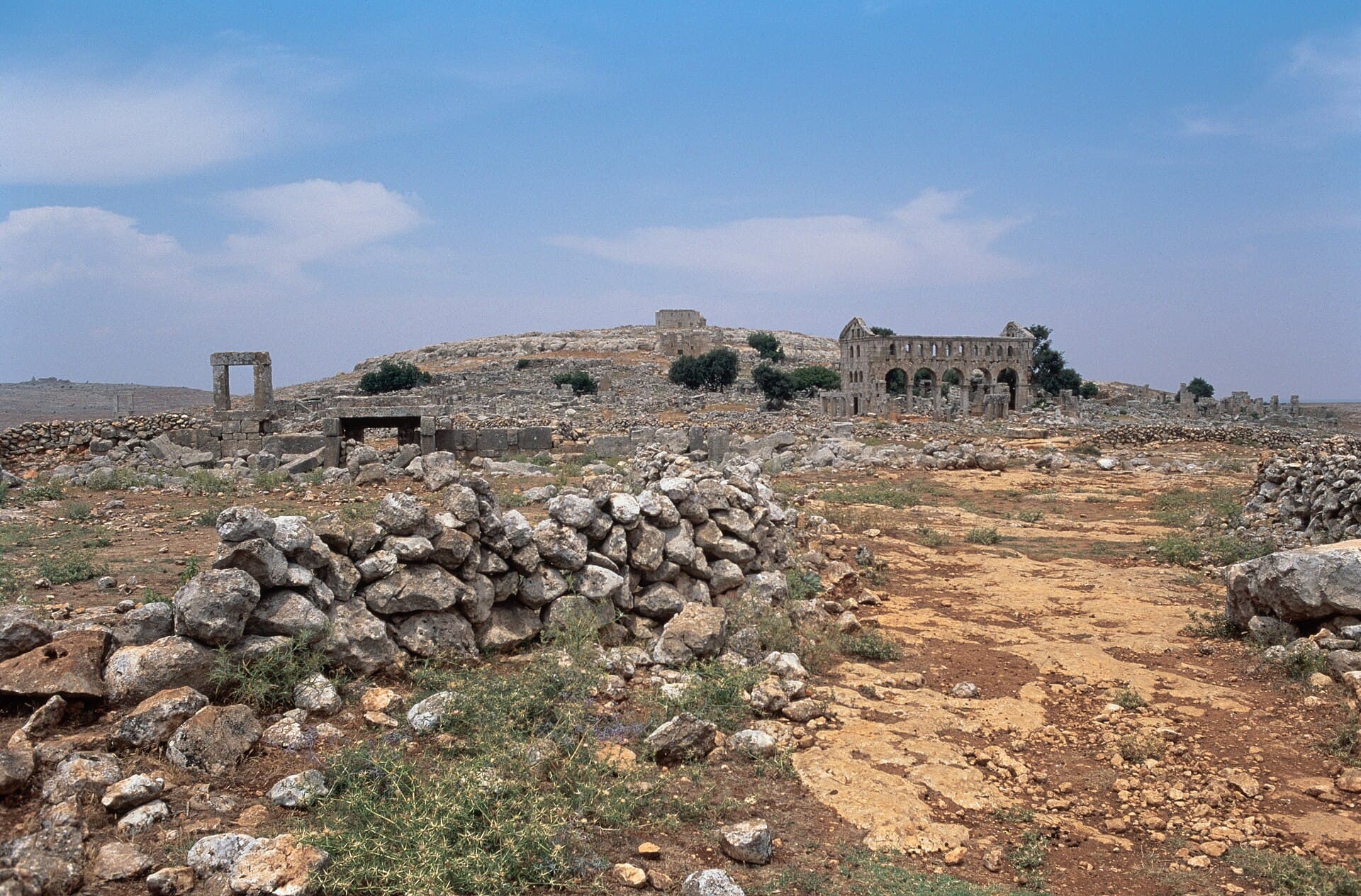
An earthquake took the outer walls and the apse of this Jebel Sem’an church. What is left stands on slender columns, the upper storey seemingly in mid-air.
- Opening hours
- Open site, daylight hours
- Entry
- Variable — confirm on arrival
- Duration
- 60 minutes
- Best time
- Spring and autumn; there is no shade at all on the site
- Period
- Byzantine
- Address
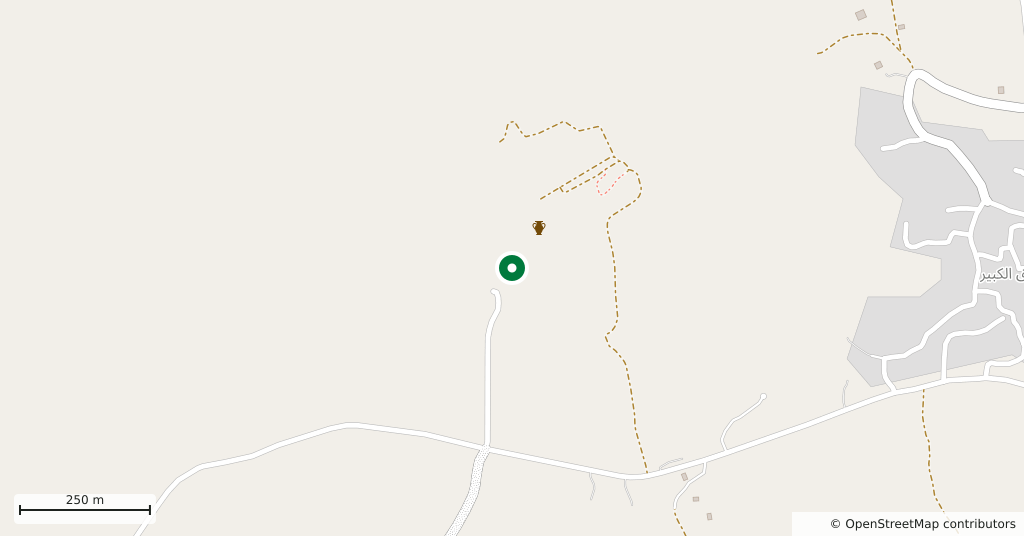
- Southern Jebel Sem'an, near Deir Sem'an, Afrin district, Aleppo
A church 26 kilometres north-west of Aleppo, in the southern part of the Jebel Sem’an, standing a little below a stony hilltop. An earthquake carried off the long walls and the apse entirely; what remains is the two gables and the nave walls riding on their columns. The columns are slender, the arches drawn up into horseshoes, and the upper storey is heavy. That is the sight that earned the building its German nickname, the “church on stilts”.
Getting there
From Aleppo you take the Afrin road as far as Deir Sem’an, where a side road winds north-east first to Basufan and then, past Burj Haidar and Fafertin, to here. There is no public transport; you hire a car and driver in Aleppo. Barad, the ancient Kaprobarada, is 5 kilometres north.
How long it takes
An hour. The basilica stands among heaps of cut stone and is visible from far off. Climbing to the chapel on the crest takes another half hour.
What you see
The basilica has three aisles. Each of the two high nave walls carries five arches, resting on four columns and on wall pilasters at the ends. Butler dated the building to the end of the 4th century; it was rebuilt in the 6th. Inside it measures roughly 19 metres long. Behind the closed east wall lay a round apse with two nearly square rooms flanking it: a diakonikon to the north opening onto the aisle by a door, and a relic chamber to the south opening through a round-arched portal. Butler found a semicircular bema in the middle of the nave.
Above the arches runs a clerestory with twice as many round-arched windows. The west gable let light in through three rows of windows as well. As at Mushabbak, the outer façades are almost entirely undecorated. The capitals are mixed — Ionic, Tuscan and Corinthian side by side — and it is not certain that all of them belong to the first building.
On the very top of the hill stand the outer walls of a single-aisled 6th-century chapel, possibly part of a monastery. Further building remains and a necropolis show that this was a larger place, already settled in Roman times.
How it stands today
The site entered the UNESCO list in 2011 as part of the Ancient Villages of Northern Syria. The landscape is nearly treeless and strewn with boulders; only in the flat hollows is the soil deep enough for grain. Displaced families sheltered in the Dead Cities during the war years; do not enter a building someone is living in, and do not photograph people without asking. Unexploded ordnance is a reported hazard in the countryside: stay on the path, keep out of collapsed buildings, and do not touch metal lying on the ground.
Don’t miss
Walk under the north colonnade and look up. The capitals are cut in different orders and the arches close right overhead; only from there does it become clear why the building looks as though it is on stilts.
Tips
- Step under the north colonnade and look up at the capitals
- Do not skip the single-aisled chapel on the crest; most visitors never climb up
- Fafertin and Burj Haidar are on the same side road; make a day of the three
- The ground is boulder-strewn and uneven; wear shoes with a firm sole
Transparency
- How this was chosen
- Written by hand; opening hours, entry fee and coordinates are kept as data. A field that is not known for certain is marked as variable rather than guessed.
- Facts checked
- September 2026
- Last updated
- September 15, 2026