Qirqbize
A small Dead City a kilometre north of Qalb Lozeh, holding the oldest house church preserved anywhere after Dura-Europos, set inside a Roman dwelling.
- Opening hours
- Open site; if a guard is present, check at the entrance
- Entry
- Variable — check at the entrance
- Duration
- 45 minutes
- Best time
- A spring morning, while the ground between the olives is green
- Period
- Roman — Byzantine
- Address
- South-east of Harim, near Qalb Lozeh, Idlib
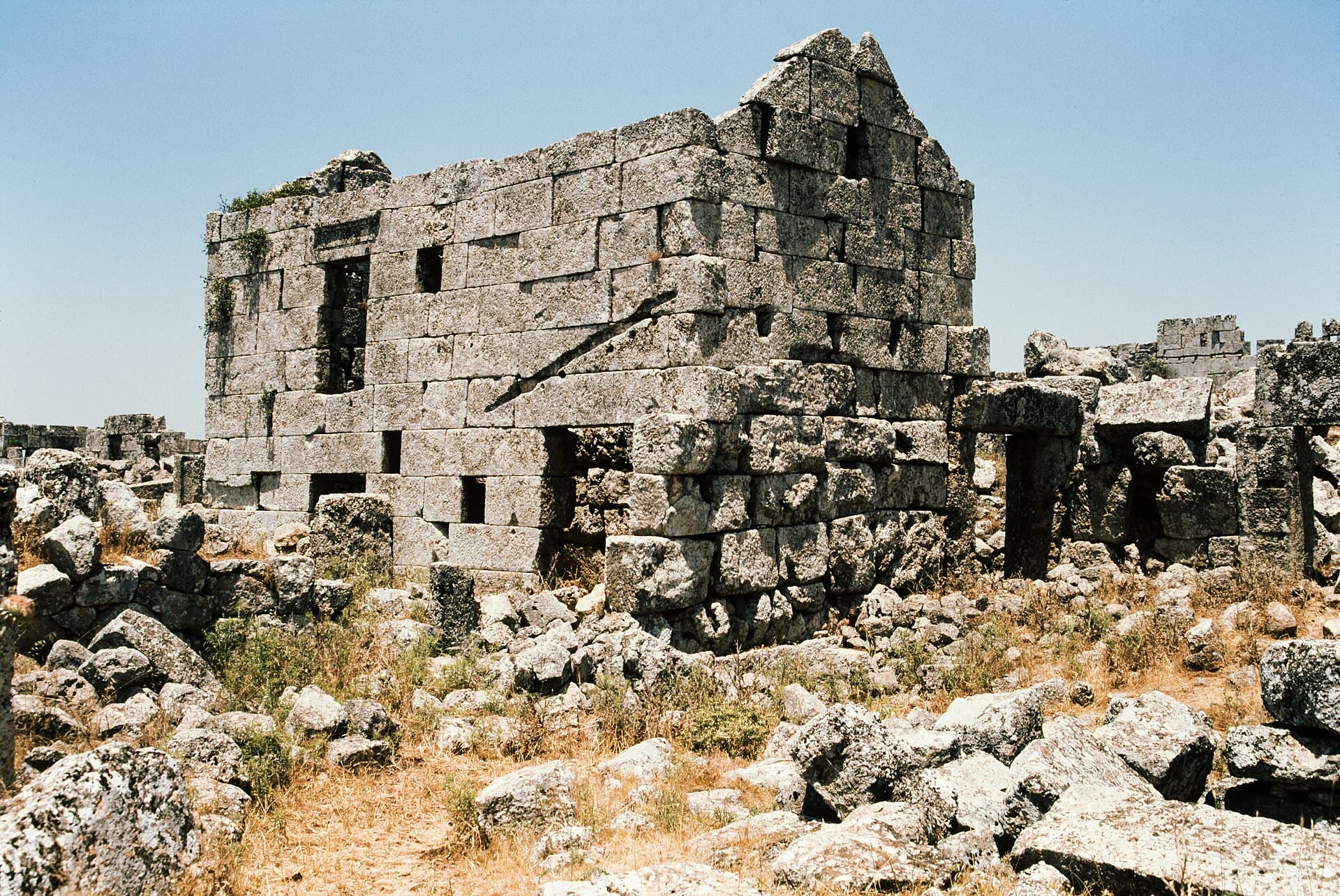
A small settlement among the olive groves, its stone houses and courtyard walls still standing. It was lived in from Roman times until at least the 7th century. One building makes Qirqbize matter far beyond its size: a house church set inside a Roman dwelling, the oldest one preserved anywhere after Dura-Europos. It dates from the beginning of the 4th century.
Getting there
North-west of Idlib, seven kilometres south-east of Harim. The church of Qalb Lozeh is less than a kilometre away and the two fit into one walk. There is no public transport; hire a car and driver in Harim or Idlib, and expect the last stretch to be unsurfaced.
How long it takes
Forty-five minutes. The site is small. Put it together with Qalb Lozeh and you have half a day.
What to see
The core of the church is an ordinary house of the 2nd century: two rooms joined by a door, each opening onto the south front, with a colonnaded porch running along that side. The first Christians met in private houses; here the wall between the two rooms was taken out, leaving a single hall facing east. The hall is about 15 metres long. At its east end is a raised platform for the altar, with seating on it for 14 clergy. There are two doors in the south wall; the other three sides are closed and the windows are rectangular.
What most people miss
The stone sarcophagus at the north side of the chancel. It held the bones of a saint, and olive oil poured in from above ran over them and out below, where pilgrims caught it in small clay flasks to carry away. Northern Syria lived on the olive, and so did its worship. Most visitors look at the hall and turn back without noticing the arrangement.
Tips
- Qalb Lozeh is under a kilometre away; make the two one walk
- Look for the altar platform at the east end and the sarcophagus beside it
- The stone is uneven; wear shoes with a firm sole
- The last stretch is a dirt track and turns to mud after rain
Transparency
- How this was chosen
- Written by hand; opening hours, entry fee and coordinates are kept as data. A field that is not known for certain is marked as variable rather than guessed.
- Facts checked
- September 2026
- Last updated
- September 15, 2026