Saint George’s Syriac Orthodox Church
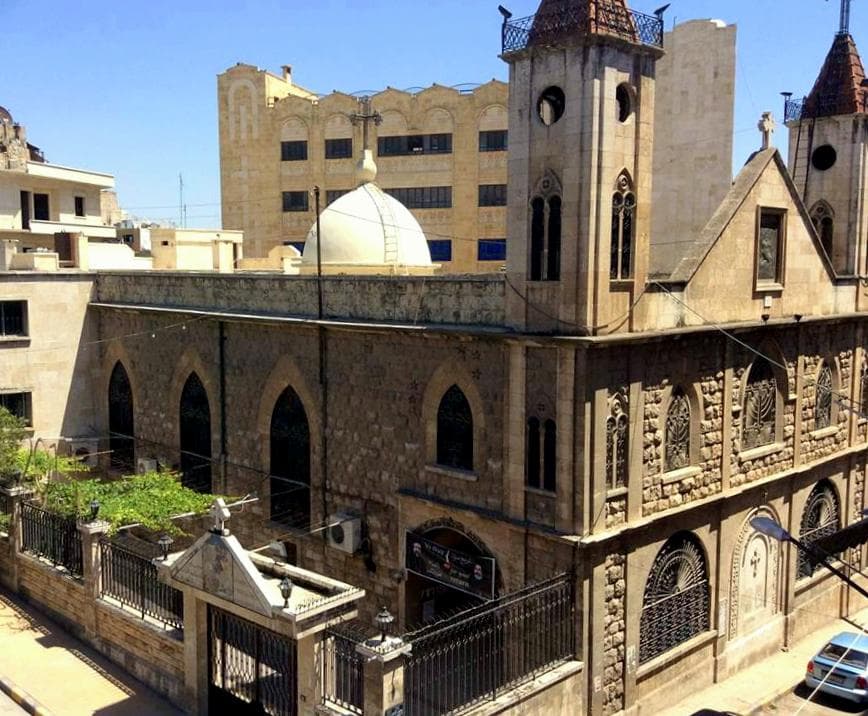
The church of the quarter that Syriacs from Diyarbakir built in Aleppo. Modelled on a church in Urfa, this dark stone building had its dome finished in 1951.
- Opening hours
- Around service times; otherwise usually locked
- Entry
- Free
- Duration
- 20 minutes
- Best time
- Sunday morning, as the liturgy ends
- Period
- Modern
- Address
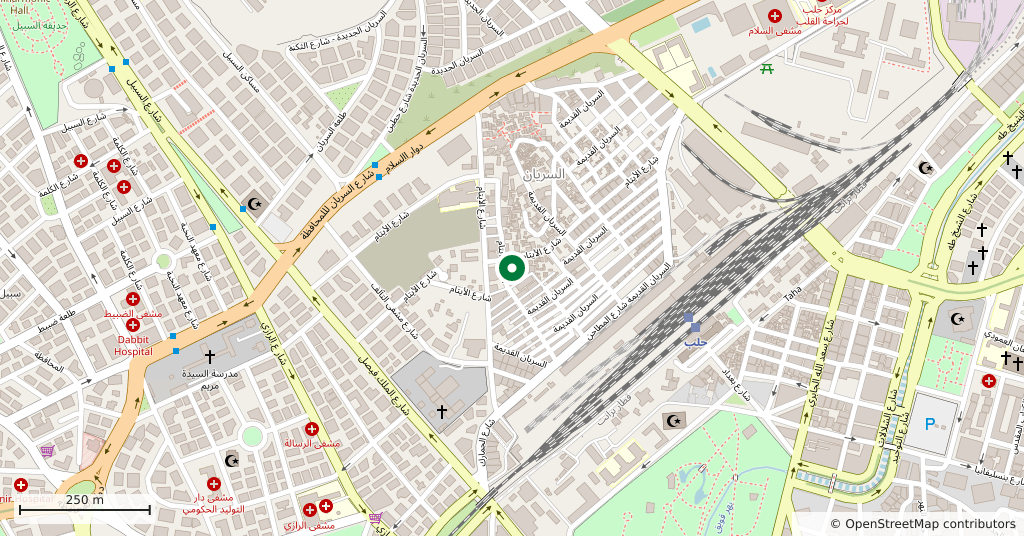
- Syriac Street, Old Syriac Quarter, Aleppo
In the Old Syriac Quarter of Aleppo, at the south-western end of Syriac Street, about 30 metres before it meets Urfa Avenue. It belongs to the Syriac Orthodox Church of Antioch.
How the quarter began
Aleppo has had a Syriac Orthodox community for a long time, but in the eighteenth century most of the Syriacs then living in al-Jdayde joined the Syriac Catholic Church. In 1895 survivors of the massacre at Diyarbakir reached Aleppo and built what is still called the Old Syriac Quarter. More refugees arrived after the First World War and the Sayfo, and the community grew; a New Syriac Quarter followed to the north.
How the church was built
The quarter’s first church was a temporary wooden one and soon too small. Donations paid for a large concrete church, begun in 1932. The model was the Church of the Apostles Peter and Paul in Urfa, where part of the community had come from. That church stood empty after the last Syriacs were driven out in 1922, and later served as a tobacco factory. The Aleppo building was inaugurated on 22 December 1935 in the presence of Patriarch Ignatius Aphrem I Barsoum, but completion took years: the finished church opened on 6 May 1953, the feast day of Saint George. It was restored in 1983 under Metropolitan Gregorios Yohanna Ibrahim.
What to see
A dark stone building, rectangular in plan and almost a plain block. A dome with a cross sits in the middle of the flat roof; it was completed in 1951 and its low drum is pierced by 12 small windows. Inside, the ceiling rests on four central columns that stand for the four Gospels. The west front ends in two rows of windows and a blind gable, with a square bell tower at each corner. The entrance is on the north side, beside the north-west corner.
Don’t miss
The shrine of Saint Severus of Antioch beside the church. And the manuscripts the community carried from Urfa. Among them: a Bible from the 12th century, a copy of the chronicle of Patriarch Michael the Syrian, two manuscripts of Bar Hebraeus, and 40 handwritten volumes of prayers for the year. They are not on display; ask and you will be told about them.
Tips
- The door is on the side street; the face you see from the lane is the west front
- Count the windows in the dome drum from inside; they barely read from outside
- If you want to see the manuscripts, ask in advance — they are not in a case
Transparency
- How this was chosen
- Written by hand; opening hours, entry fee and coordinates are kept as data. A field that is not known for certain is marked as variable rather than guessed.
- Facts checked
- September 2026
- Last updated
- September 15, 2026