Tell al-Hasakah
A mound in central Hasakah on the Khabur, where a 2008-2011 dig exposed a Byzantine cathedral, a baptistery and a Neo-Assyrian building; access today is unclear.
- Opening hours
- Not confirmed; the site is walled, permission to enter should be checked locally
- Entry
- Unknown — access not confirmed
- Duration
- 45 minutes
- Best time
- The cooler months; summer afternoons in Hasakah are very hot
- Period
- Neo-Assyrian — Byzantine — Arab-Islamic
- Address
- City centre, left bank of the Khabur, Hasakah
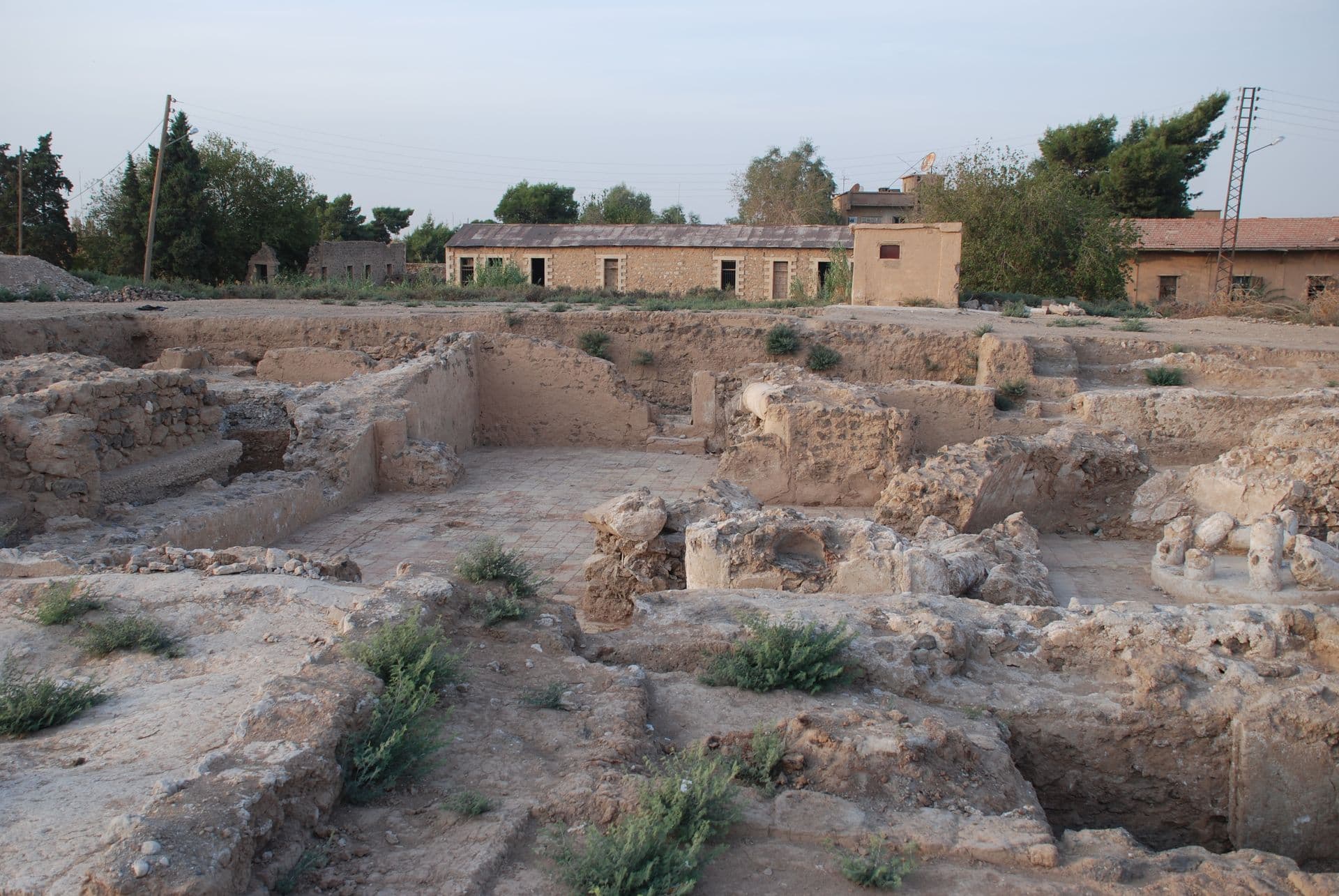
Tell al-Hasakah is a two-and-a-half-hectare mound rising on the left bank of the Khabur in the centre of Hasakah. It is the only excavated historic site inside the city. The 2008-2011 excavation opened three levels, one above the other: at the bottom the corner of a Neo-Assyrian building, in the middle a basalt Byzantine cathedral, and on top an Arab-Islamic level dated between 700 and 1500. Whether it is open to visitors could not be confirmed in the past year.
Where it is
The mound stands in the city centre, 1700 metres from the point where the Khabur and the Jaghjagh meet. It rises 329 metres above sea level and is one of the largest hills in the province. For many years it carried the Sa’d ibn Abi Waqqas barracks, built during the French Mandate. In 2002 the hill passed from the Ministry of Defence to the Ministry of Culture, it was walled off, and the French buildings were restored.
What the excavation found
A national team led by Abdulmasih Bagdo, director of antiquities in Hasakah, dug here between 2008 and 2011. The most striking find is the cathedral in the Byzantine level: built of basalt, plastered, 31 metres by 18, with three aisles. The aisles are divided by basalt column bases and plaster capitals carved with crosses, and the fired-brick floor has geometric patterns. In places the walls still stand more than two metres high. The building is estimated to have held 650-700 people.
The cathedral belonged to a church and cemetery complex founded in the 4th century and used until the 11th century. South of the sanctuary lie a baptistery and an intact baptismal basin; north of it a deacons’ room and two large jars were found.
Which city was this
That is not settled. The excavators’ hypothesis is that it was the Assyrian town of Makrisa, or Magarisu, named in tablets from Dur-Katlimmu (Tell Sheikh Hamad) further down the Khabur. It is a proposal, not an identification proven by an inscription.
Don’t miss
The reliquary above the baptismal basin. It held martyrs’ bones, and it was arranged so that oil poured over it would seep through the bones and run down into the basin. Because the state of the cathedral after 2011 has not been confirmed, it is not known whether this arrangement can still be seen in place.
Where it stands now
Not confirmed. The city of Hasakah has been under the administration of government security forces since 2 February 2026, but no source from the past year says whether the site is open to visitors. In July 2020 the Hasakah antiquities directorate took the municipality to court over digging and construction inside the mound’s protected zone; the dispute concerned a retaining wall and a project for 600 shops. The cover photograph was taken in October 2009 while excavation was under way; the restored French buildings are visible behind.
Tips
- The site is walled; ask at the Hasakah antiquities directorate before going in
- Do not step on the floor or wall remains; the brick and plaster are exposed
- Ask permission before photographing near official or military buildings
- The Jaghjagh River entry describes the confluence beside the mound; read them together
Transparency
- How this was chosen
- Written by hand; opening hours, entry fee and coordinates are kept as data. A field that is not known for certain is marked as variable rather than guessed.
- Facts checked
- September 2026
- Last updated
- September 15, 2026