Qal’at Sukkara
An Ayyubid-Mamluk hilltop garrison on Mount Abdulaziz, 35 km south-west of Al-Hasakah: four ruined towers, five rock-cut wells, a stucco dome, and access notes.
- Opening hours
- Open ruin; no guard or opening hours could be confirmed
- Entry
- Varies — confirm on the spot
- Duration
- 90 minutes
- Best time
- Spring, early in the morning; the slope is steep and has no shade
- Period
- Ayyubid — Mamluk
- Address
- Mount Abdulaziz, about 35 km south-west of Al-Hasakah
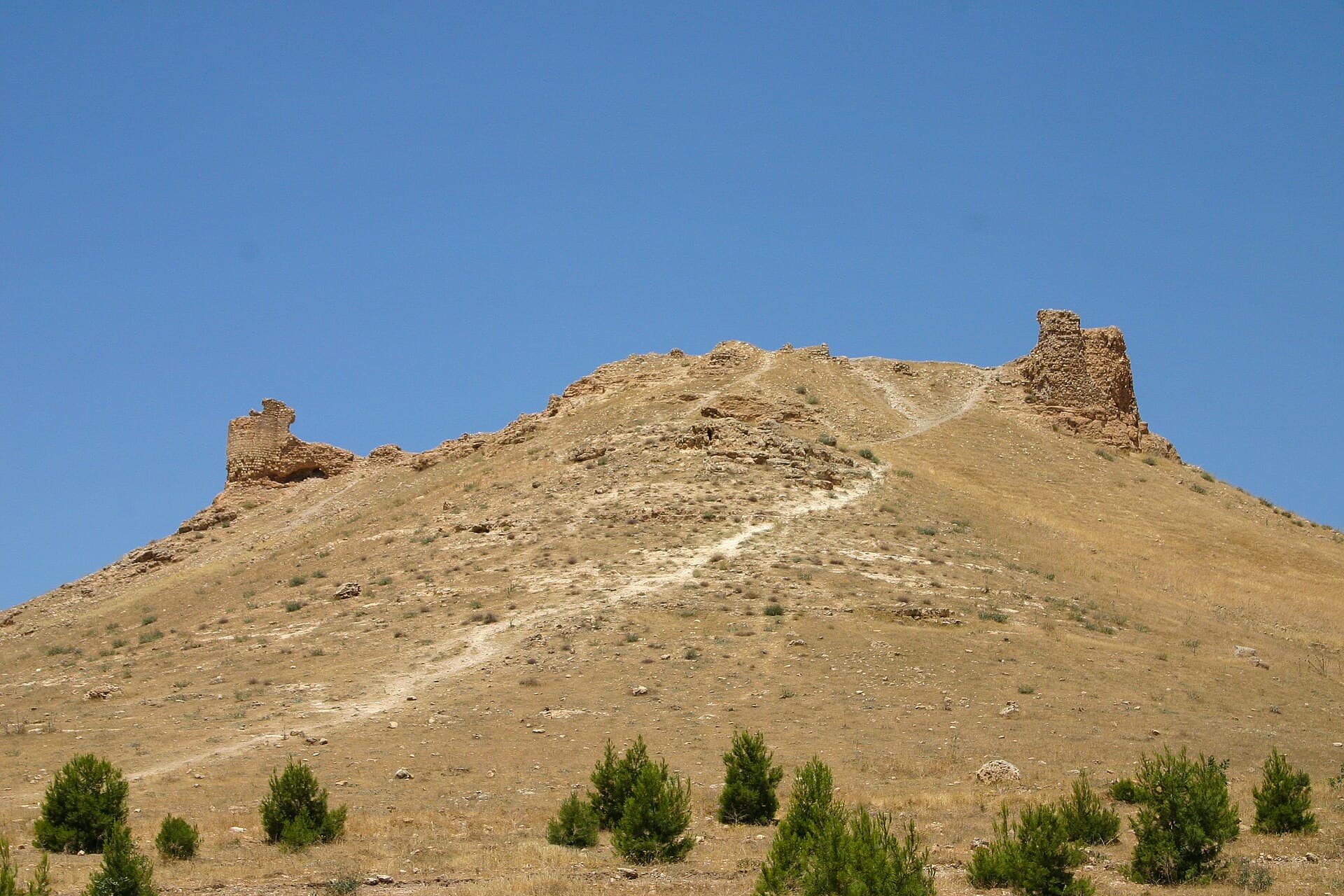
Qal’at Sukkara is a small Ayyubid-Mamluk garrison fort on a high ridge of Mount Abdulaziz, some 35 kilometres south-west of Al-Hasakah. It was less a castle than a lookout post, built to watch the plain north of the mountain and the pass that cuts through it from north to south. The Ayyubids were the dynasty founded by Saladin, and the Mamluks succeeded them; between them they cover the 12th and 13th centuries. Today the remains of four towers and five wells cut into the rock of the courtyard can be made out. The site has never been excavated, and present access could not be confirmed.
Where it stands
The Al-Hasakah–Mughlujah road runs along the foot of the hill the fort sits on. The hill is natural and defended on every side: its slopes drop at up to 70 degrees in places, and the fort stands about 300 metres above the surrounding plain. The mountain itself has its own entry on this site, Mount Abdulaziz.
What to see
The walls are built of irregular courses of limestone, each 20 to 40 centimetres high. The remains of four towers are still standing. On the ground floor of the second tower is a dome whose inner face carries geometric stucco decoration. Three more towers have collapsed completely, leaving only faint foundations, and the curtain walls are down to their footings.
In the south-east corner of the courtyard are five round wells cut into the rock. They are 3 to 8 metres deep, with bases 3 to 7 metres across. The gate is thought to have stood between the 3rd and 4th towers, although its line can no longer be traced.
The sources disagree on the size of the fort: the Arabic Wikipedia gives 150 by 80 metres, the English Wikipedia 220 by 150 metres. No figure measured on site could be found.
When it was built
The fort is dated to the Ayyubid and Mamluk periods, the 12th and 13th centuries. The date rests on its architectural style and on potsherds scattered across the surface; no excavation or historical study has been carried out.
What was done in 2009
In June 2009 the Al-Hasakah antiquities department shored up the foundations of the 2nd, 3rd and 4th towers. It covered the courtyard wells with iron grilles. Trees were planted around the hill, and a stairway was built from its foot up to the fort. The cost was given as 2 million SYP.
Access and safety
On 7 August 2023 the newspaper Al-Watan reported illegal digging around the fort and on the mountain, so there may be looters’ pits on the hilltop. Mount Abdulaziz changed hands several times during the war, and no dated report on unexploded ordnance or clearance for this site could be found. The region came under a new administration in early 2026. Whether the fort can be reached today has not been confirmed by an independent source; this page tells you what the fort is, not that you can go there today.
Don’t miss
The dome on the ground floor of the second tower. The rest of the fort is rough limestone and traces of foundations. The geometric stucco on the inside of the dome shows that even this small military post was not left bare.
Tips
- Ask in Al-Hasakah about access and the state of the road first; present access is unconfirmed
- The slope is very steep in places; a stairway was built in 2009 but its present state is unknown, so do not take shortcuts
- Keep away from the edges of the wells and of looters' pits
- There is no shade or water on the hill; bring both
Transparency
- How this was chosen
- Written by hand; opening hours, entry fee and coordinates are kept as data. A field that is not known for certain is marked as variable rather than guessed.
- Facts checked
- September 2026
- Last updated
- September 15, 2026