Tell Halaf
A whole prehistoric culture is named after this village. The sculptures of Aramaean Guzana shattered in a fire in Berlin and were rebuilt from the fragments.
- Opening hours
- Open ground, daylight hours; confirm on arrival
- Entry
- Variable — confirm at the entrance
- Duration
- 90 minutes
- Best time
- Morning; no shade is left on the mound by the afternoon
- Period
- Halaf culture — Aramaean — Assyrian
- Address
- Tell Halaf village, south-west of Ras al-Ayn; 94 km north-west of Hasakah
An archaeological culture takes its name from a village here: Halaf. On this mound beside Ras al-Ayn, where the Khabur crosses from Turkey, a society lived between about 6100 and 5400 BC that made burnished pottery painted with geometric and animal designs. It was the first Neolithic culture ever excavated, and ever since, wherever that pottery turns up across northern Mesopotamia, it is called Halaf. There is a second city on the mound. In the tenth century BC the Aramaean kingdom of Bit Bahiani made this its seat and called it Guzana — the Gozan of the Hebrew Bible.
Getting there
94 kilometres north-west of Hasakah by road, a few kilometres south-west of Ras al-Ayn and right up against the Turkish border. About two hours by car. This is the opposite direction from Hasakah’s other tells: it wants a day of its own, and it wants someone to tell you first whether the road is open that day.
How long it takes
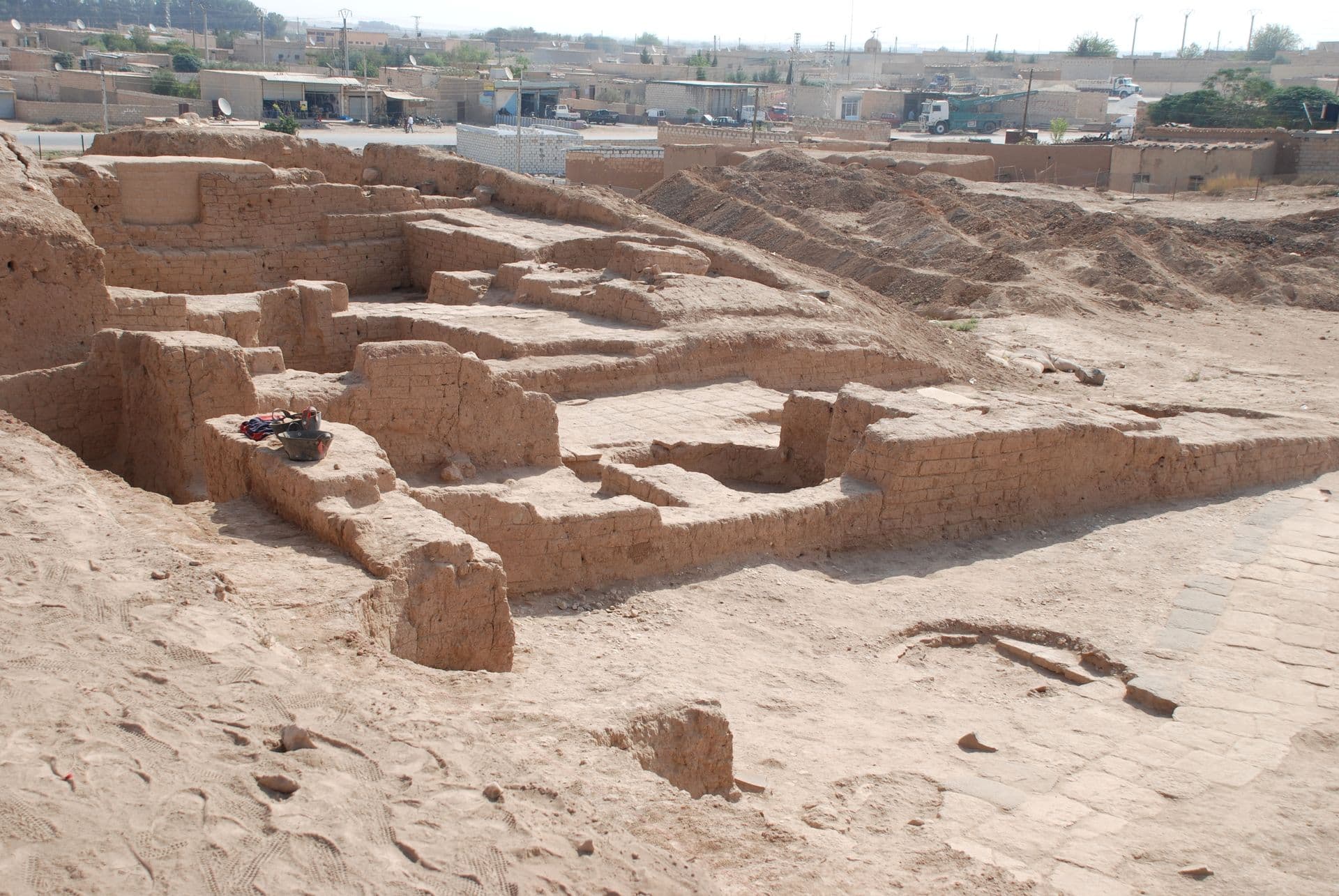
An hour and a half. The top of the mound is small; the time goes on working out which walls belong to which city.
What to see
The mound was the citadel of the Aramaean and Assyrian city; the lower town ran 600 metres north to south and 1000 east to west. Two palaces were excavated on the summit. The western one is the hilani built by King Kapara: a Neo-Hittite building whose façade was faced with statues and carved orthostat reliefs. The eastern one was the residence of the Assyrian governors — the city was reduced to an Assyrian province in 808 BC. What stands today is wall footings and cut faces of mud brick, and the houses and shops of the present village begin immediately behind the excavation.
What not to miss
The story of the sculptures. The German diplomat Max von Oppenheim found the mound in 1899 while scouting a route for the Baghdad Railway, after villagers told him of stone idols buried in the sand. He uncovered several major pieces within three days. Having no permit, he had them all reburied, and came back twelve years later to dig. Two thirds of what he found went to Berlin; thirty-five pieces stayed in Aleppo and became the core collection of the National Museum there. His private museum in Berlin burned in 1943 after a phosphorus bomb: the wooden and limestone pieces were destroyed, and the basalt ones shattered into dozens of fragments from thermal shock as the fire was fought. Between 2001 and 2010 more than thirty sculptures were rebuilt from around 27000 fragments. So to see the grandest part of this mound you have to go to Berlin or to Aleppo — and what you see there is stone that has been rescued twice.
The site today
A joint Syrian and German excavation restarted in 2006. The area around the site changed hands in the cross-border operation of 2019 and passed to the transitional government’s administration in early 2026. This close to the border line there is no fixed visiting arrangement; ask in Hasakah about both the road and the site before you go, and keep away from the border strip.
Tips
- Separate the two palaces: Kapara's hilani to the west, the Assyrian governor's residence to the east
- The sculptures are not here — they are in Berlin and in the National Museum of Aleppo
- The site is very close to the border; keep off the border strip and be careful about photographs
- The village starts immediately behind the excavation; walk around it without entering house yards
- Do not put this in the same day as Hasakah's other tells; the direction is entirely opposite
Transparency
- How this was chosen
- Written by hand; opening hours, entry fee and coordinates are kept as data. A field that is not known for certain is marked as variable rather than guessed.
- Facts checked
- September 2026
- Last updated
- September 15, 2026