Where to stay in Damascus, neighbourhood by neighbourhood
Old City, Salhiyeh or Mezzeh? Walking distances, evening noise and how easily a taxi turns up at night, for every Damascus district — and no hotel names.
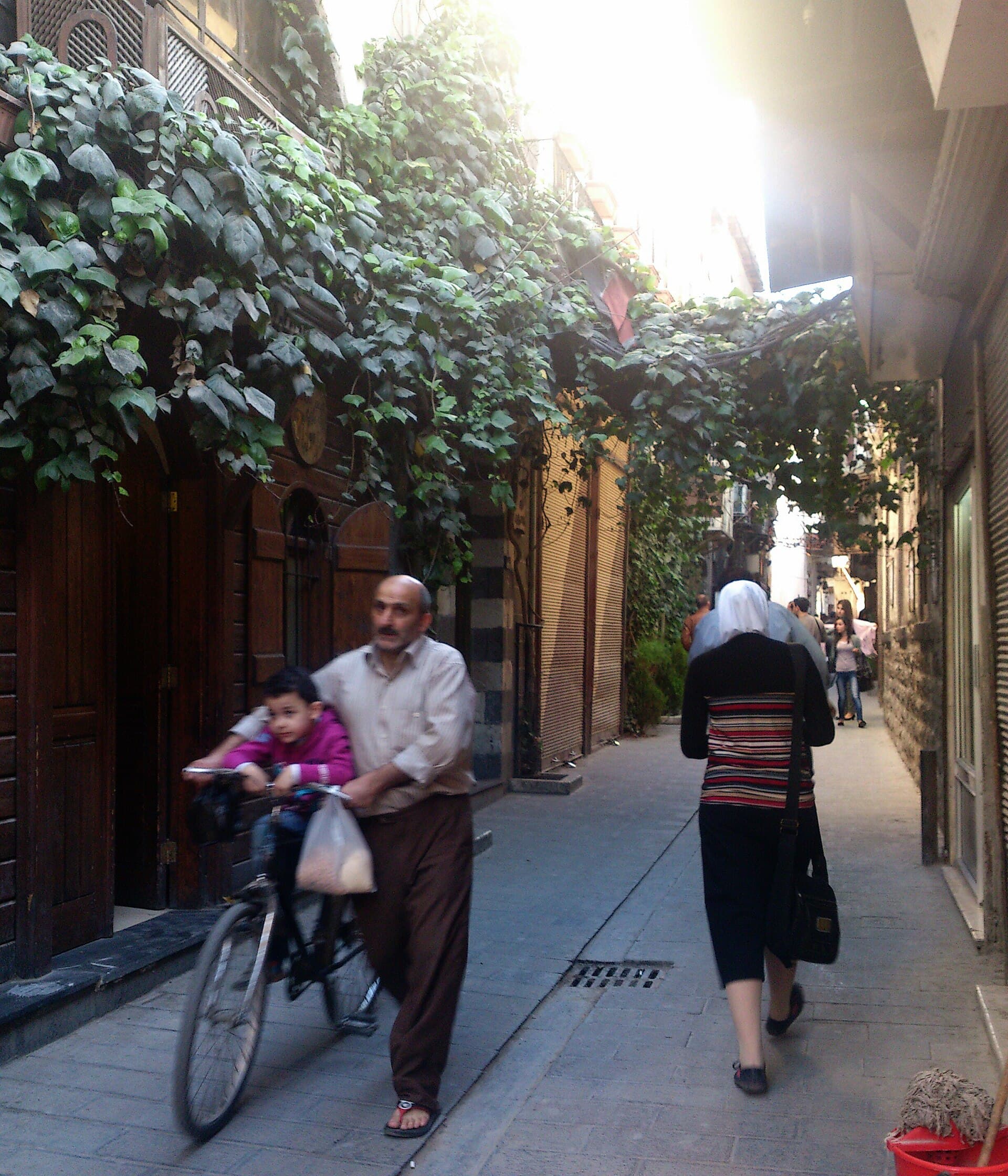
Choosing a base in Damascus is less about the hotel than about the district. Stay inside the Old City and you walk to the Umayyad Mosque after breakfast. Stay in Mezzeh and you take a taxi to the same gate every morning. What follows is the shape of each district: who it suits, how far you walk, how loud the evening is, and whether a car turns up at night. No hotels are named here; this site recommends no accommodation, and the measure is the district itself. Booking, payment and generator hours sit on the accommodation page.
Qaymariyya and Bab Touma: inside the walls
Accommodation in the Old City clusters in small conversions of courtyard houses: a handful of rooms, a lemon tree and a fountain in the middle, a wooden chamber upstairs. From Qaymariyya the Umayyad Mosque is 400 metres in a straight line, which is 10 minutes through the lanes. From Bab Touma it is 800 metres to the same mosque and 500 metres to Bab Sharqi. The whole first day of a three-day plan starts at your door: the mosque, Al-Hamidiyah, Al-Bzouriyah, the khans, Straight Street.
The price is the width of the lanes. No car reaches the door; the last hundred metres are on foot and wheels do not roll on that stone. With a heavy suitcase, that alone can settle the question. The second price is sound: a courtyard carries voices, so a conversation in the room opposite arrives in yours, and the streets around Bab Touma stay busy late. Mornings start early too, with the call to prayer, church bells and shutters landing in the same hour.
Shaghour and the Bab Sharqi side
The southern and eastern parts of the Old City are quieter. Fewer houses have been converted, the lanes empty out, and the evening closes early. The walk to the Umayyad Mosque is still under 15 minutes. For a light sleeper who does not want to give up the Old City, this is the sensible middle. The trade is a short walk to find dinner.
Marjeh, Souq Saroujah and Hariqa: the centre
Marjeh Square is the transport hub of Damascus and sits 800 metres from the Umayyad Mosque. Souq Saroujah lies just north of the same axis, 900 metres from the mosque. Two things work in its favour: cars run in every direction and the Old City is on foot. Two things work against it: traffic noise continues through the night, and the streets do not have the grain of the Old City. For anyone catching a long-distance coach to Aleppo or Homs, the practical side wins.
Salhiyeh: the new city’s high street
Salhiyeh climbs the lower slope of Mount Qasioun and stands 2700 metres from the Umayyad Mosque, which is a 15-minute taxi ride depending on traffic. The district works by day and by night: shops, restaurants, pharmacies, banks and exchange offices along one line. There is something to see on foot as well, since the medieval Hanbali quarter is above you and the mosque of Ibn Arabi is 2600 metres away. If you accept the daily ride into the Old City, this is the most workable side of the city.
The other face of Salhiyeh shows up in the morning traffic. The road down to the Old City thickens during office hours, and a 15-minute distance can stretch to 25. Leave early and you never meet it; wait until nine and you meet it daily.
Abu Rummaneh and Shaalan
Abu Rummaneh is a quiet grid of wide, tree-lined streets, and the embassies are here. Rooms are few and expensive, and in return the nights are close to silent. Shaalan sits next door as the shopping street, with its shops, sweet makers and restaurants open late. Both put Salhiyeh within walking distance and the Old City within a taxi ride.
Mezzeh and the west
Mezzeh spreads west of the centre in wide roads and apartment blocks, with universities and hospitals on this side. Rooms tend to be newer and cheaper. In return, everything runs on taxis: reaching the Old City and coming back means crossing the whole city twice a day. The airport is no help either, since it lies 30 kilometres south-east of the centre and the run from the west cuts through everything.
Which district for how many nights
For two nights the Old City wins outright: most of what you came to see is on foot, and none of your time goes on a taxi seat. From four nights the balance shifts, because eating in the same three lanes every evening wears thin, and Salhiyeh or Shaalan gives the day another shape. Travellers staying longer than a week often split the stay in half, the first part inside the walls and the second in the new city. Moving a suitcase once costs less than waiting for a car every day.
With children, or with limited mobility, the sum is different from the start. Narrow lanes, high thresholds and steep stairs are the Old City standard, and a lift is the exception. In that case a level floor in the centre or in Salhiyeh takes far less out of the day.
Nights: noise, taxis and getting back
Waiting for a taxi in an Old City lane does not work, because no car can enter. Plan the return from a gate: walk out to Bab Touma or Bab Sharqi and find a car in the square. Local ride apps do run — YallaGo, Shahm, Tfadal, ZAKINN — but each needs data, so the line has to be live.
The second question is power. Cuts are daily and the hours shift; lifts, hot water and wifi mostly run off a generator. Ask at check-in which hours the generator covers. The infrastructure page explains how that rhythm works. Friday mornings are calm across every district, shops close for an hour or two around midday prayer, and the day then opens again.
Tips
- Qaymariyya to the Umayyad Mosque is 400 metres: the Old City means walking
- No car reaches a lane door; count on that if your suitcase is heavy
- For quiet, look at Shaghour or Abu Rummaneh; Bab Touma goes to bed late
- Salhiyeh is 2700 metres out but has shops, banks and exchange on one line
- Plan the night return from a gate — cars cannot enter the Old City lanes
Transparency
- How this was chosen
- This page carries the fastest-ageing information on the site: visa rules, exchange rates, border crossings and SIM prices change several times a year. The verification date above says when the facts were last put through their sources; for anything later, check your own foreign ministry travel advice and a Syrian consulate. No figure that is not known for certain is written here.
- Facts checked
- September 2026
- Last updated
- September 15, 2026