Arwad Castle and Museum
The stone castle at the heart of Arwad island: a 110 by 58 m plan, a lion-and-palm relief at the gate, a former prison and a museum of Amrit and Tell Kazel finds.
- Opening hours
- Varies — ask at the jetty or at the gate
- Entry
- Varies — check at the gate
- Duration
- 60 minutes
- Best time
- Morning, before the midday heat and the crowds
- Period
- Crusader — Mamluk — Ottoman
- Address
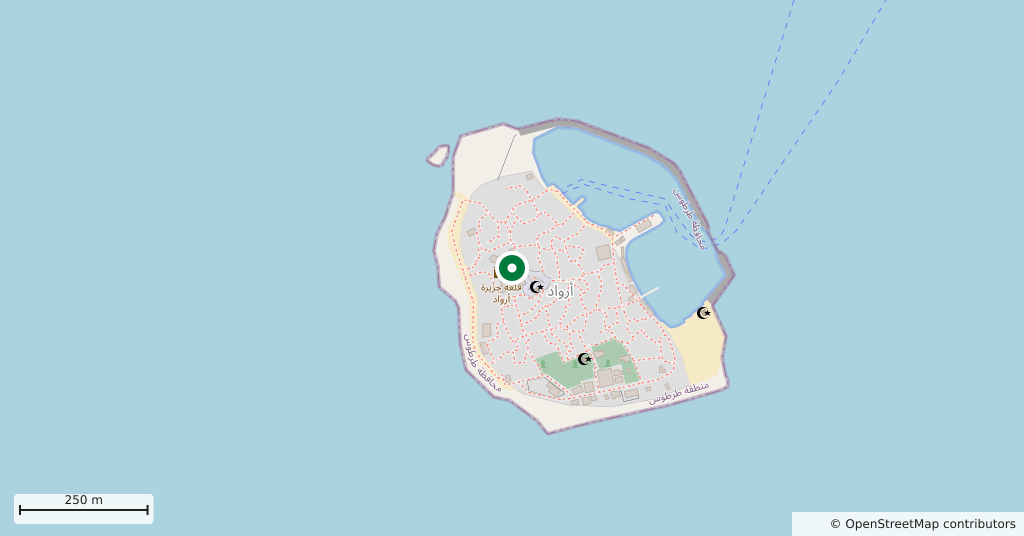
- Centre of Arwad island, Tartus governorate
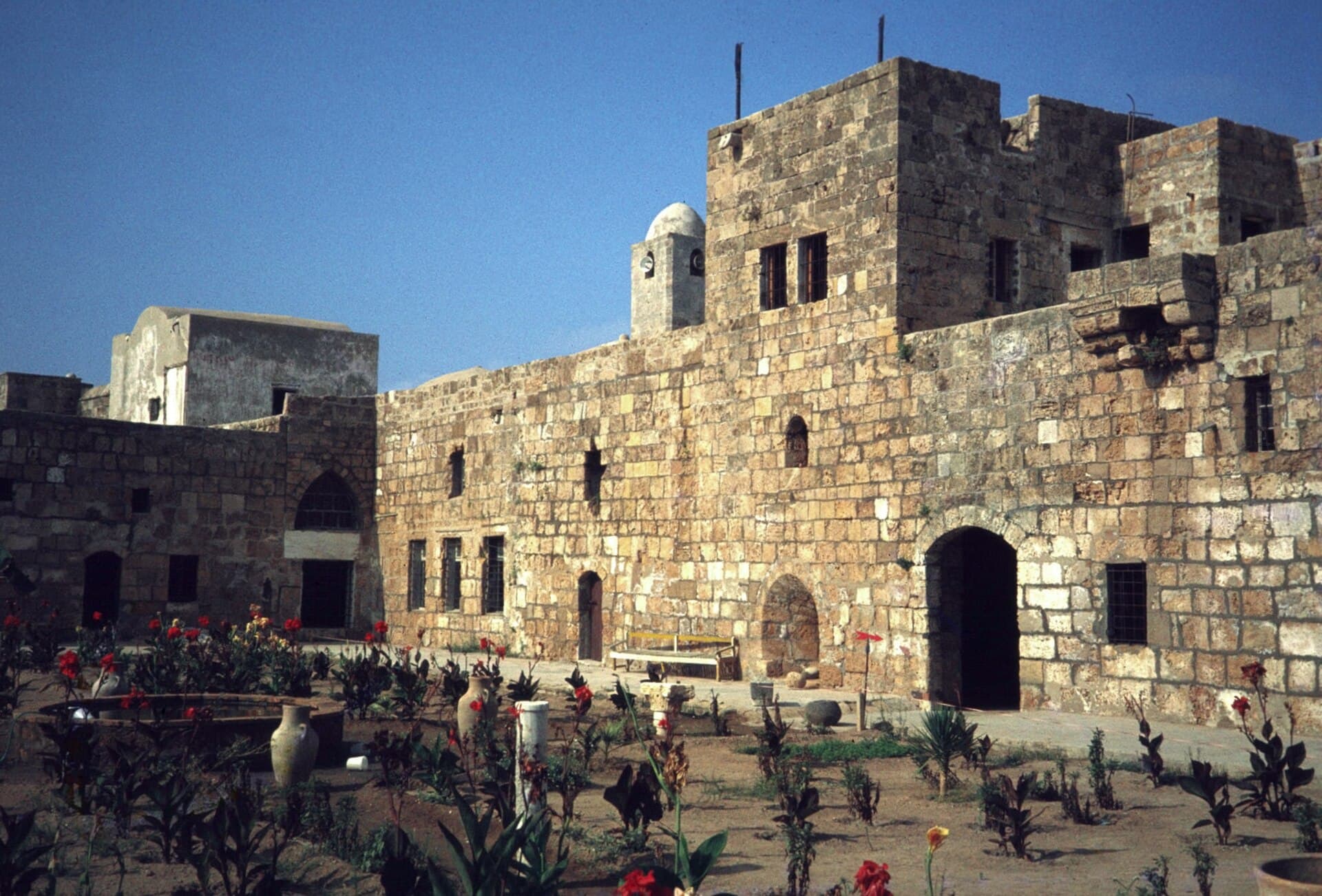
A roughly rectangular castle in the middle of Arwad island, surrounded by the houses of the town. Its plan measures about 110 m by 58 m and its highest point reaches 17 m. It rises on Canaanite foundations, served as an Ottoman barracks and a French Mandate prison, and since 1985 it has housed the island’s museum.
Getting there
Boats from the jetty on the Tartus corniche cross to the island in about twenty minutes. From the harbour it is a walk of a few minutes through narrow lanes; the island is small and the castle stands in the middle, so it is hard to get lost.
When it was built
Here the sources part ways. Arabic Wikipedia and the Commons descriptions tie the walls and the castle to the Crusader period and the Knights Templar. The Arab Encyclopedia dates the present building to the 8th century AH, the 14th century AD. The two may be describing different phases of the same structure; which phase the standing walls belong to is not certain. What is certain is that the island fell to the Mamluks in 1302: Arwad was the last Crusader foothold in the Levant.
Barracks, prison, museum
Under the Ottomans the castle was a barracks. During the French Mandate it became a prison, and members of the Syrian national movement were held here. After independence in 1946 it became a local museum, and the present Arwad Museum was founded in 1985. The castle was registered by ministerial decision in 1958.
What there is to see
The castle has three parts. The first is a defensive courtyard of 25 m by 20 m, together with the south-east tower. In the middle is a service square of 45 m by 25 m, ringed by 18 vaulted rooms. Innermost is a second defensive courtyard of 21 m by 8 m, closed by walls 7 m high. There are towers at all four corners: three round and one rectangular.
What is in the museum
The museum has two wings. In the archaeology wing, two halls hold finds from Arwad, two from Amrit, two from Tell Kazel and two from underwater excavations. The folk traditions wing has two halls of traditional copperwork, rooms for seashells, boats and fishing, and a modern art hall. These rooms are the museum’s counterpart to the boatbuilding and fishing you pass on the shore.
What most people miss
The relief on either side of the main gate: a lion standing in front of a palm tree. It is read as the arms of the Lusignan dynasty, and it is the clearest trace in stone of the castle’s Crusader past. From the terrace, Tartus is visible whole across the water.
Tips
- Look closely at the lion-and-palm relief on both sides of the main gate
- Go up to the terrace; Tartus is visible whole across the water
- Ask about museum hours and the last boat back before you cross
- The Ayyubid Tower on the harbour front fits into the same walk
Transparency
- How this was chosen
- Written by hand; opening hours, entry fee and coordinates are kept as data. A field that is not known for certain is marked as variable rather than guessed.
- Facts checked
- September 2026
- Last updated
- September 15, 2026