St George’s Syriac Orthodox Cathedral, Hasakah
The Syriac Orthodox cathedral finished in 1943 in the heart of Hasakah’s church quarter: a dome with 12 windows, two bell towers, how to find it, who worships there.
- Opening hours
- Open for services; ask at the church about visiting times
- Entry
- Free
- Duration
- 30 minutes
- Best time
- Sunday morning, for the liturgy and the choir; check the time beforehand
- Period
- 20th century · Syriac Orthodox
- Address
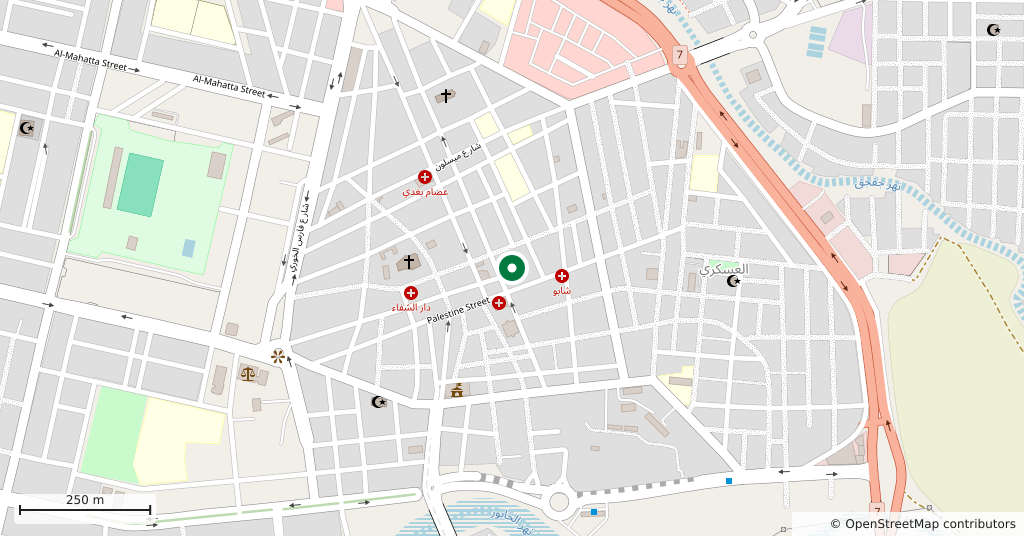
- Church quarter, north of Souq al-Hal, Hasakah
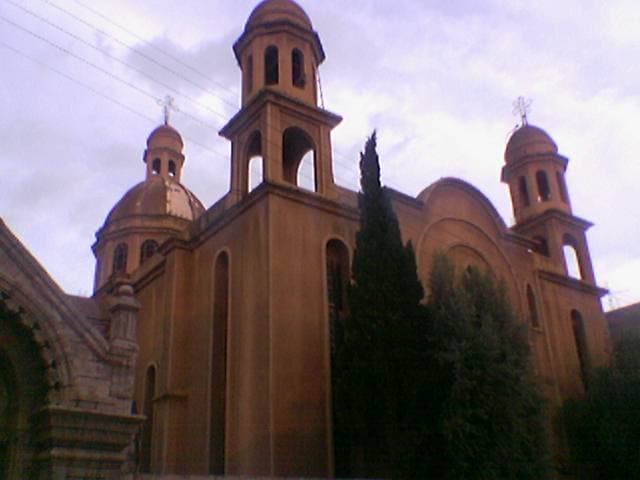
St George’s Cathedral — Mar Jirjis in Arabic — is the seat of the Syriac Orthodox Archdiocese of the Jazira and the Euphrates. It was finished in 1943 and stands in the middle of Hasakah’s old church quarter, 500 metres north of the Khabur river. Few buildings show more clearly how the town took shape in the 20th century. It is not a monument but a working church, and it fills on Sundays.
Why Hasakah has a cathedral
Before the First World War Hasakah was a place of little account. Then Armenian and Syriac refugees arrived, and for a time most of the town was Christian. The Syriac Orthodox community grew large enough for an archdiocese to be founded in 1933. The cathedral followed ten years later, in 1943.
Getting there
The cathedral sits in the quarter where the town’s churches cluster within walking distance of each other. It is 300 metres north of Souq al-Hal, the vegetable market. The Syriac Catholic Cathedral of the Assumption is 200 metres to the west, the Armenian Catholic church 200 metres to the north-west and the Chaldean Catholic church 400 metres to the north. From the market it is a few minutes on foot.
What to see
The plan is a Latin cross. A dome rises over the crossing, and its drum is pierced by 12 round-arched windows. Two narrower arms extend the west and east ends, and the east arm carries two bell towers. The roofs are pointed barrel vaults.
The cathedral is more than a place of worship: it houses a centre for religious education and the Mar Ephrem Syriac Choir.
The community today
Before the civil war the archdiocese counted between 50 and 60 thousand faithful. Half of them lived in Qamishli and about 15 thousand in Hasakah. Otmar Oehring of the Konrad Adenauer Foundation estimates that the number of Syriac Orthodox in Hasakah fell from 17500 to 8000 between 2011 and 2019.
Metropolitan Mar Eustathios Matta Roham, in office since 1988, left for Vienna during the war years. Since August 2017 the metropolitan has been Mar Maurice Yakub Amsih.
Don’t miss
The choir. Its namesake, Ephrem, was a 4th-century church father who wrote hymns in Syriac, and the liturgy here is still chanted in Syriac, a branch of Aramaic. Service and choir times are not published anywhere reliable, so ask at the church before a Sunday visit.
Tips
- Ask before taking photographs during a service
- The church may be locked outside services; ask at the church or in the quarter before you go
- Step back from the building to count the 12 windows in the drum of the dome
- The Syriac Catholic and Chaldean churches are within 200 to 400 metres; fold them into the same walk
Transparency
- How this was chosen
- Written by hand; opening hours, entry fee and coordinates are kept as data. A field that is not known for certain is marked as variable rather than guessed.
- Facts checked
- September 2026
- Last updated
- September 15, 2026